IRCC translation requirements: a guide for consultants
What IRCC asks for when a client's document is not in English or French, who is allowed to translate it, and how your practice can check every translation before it goes in.
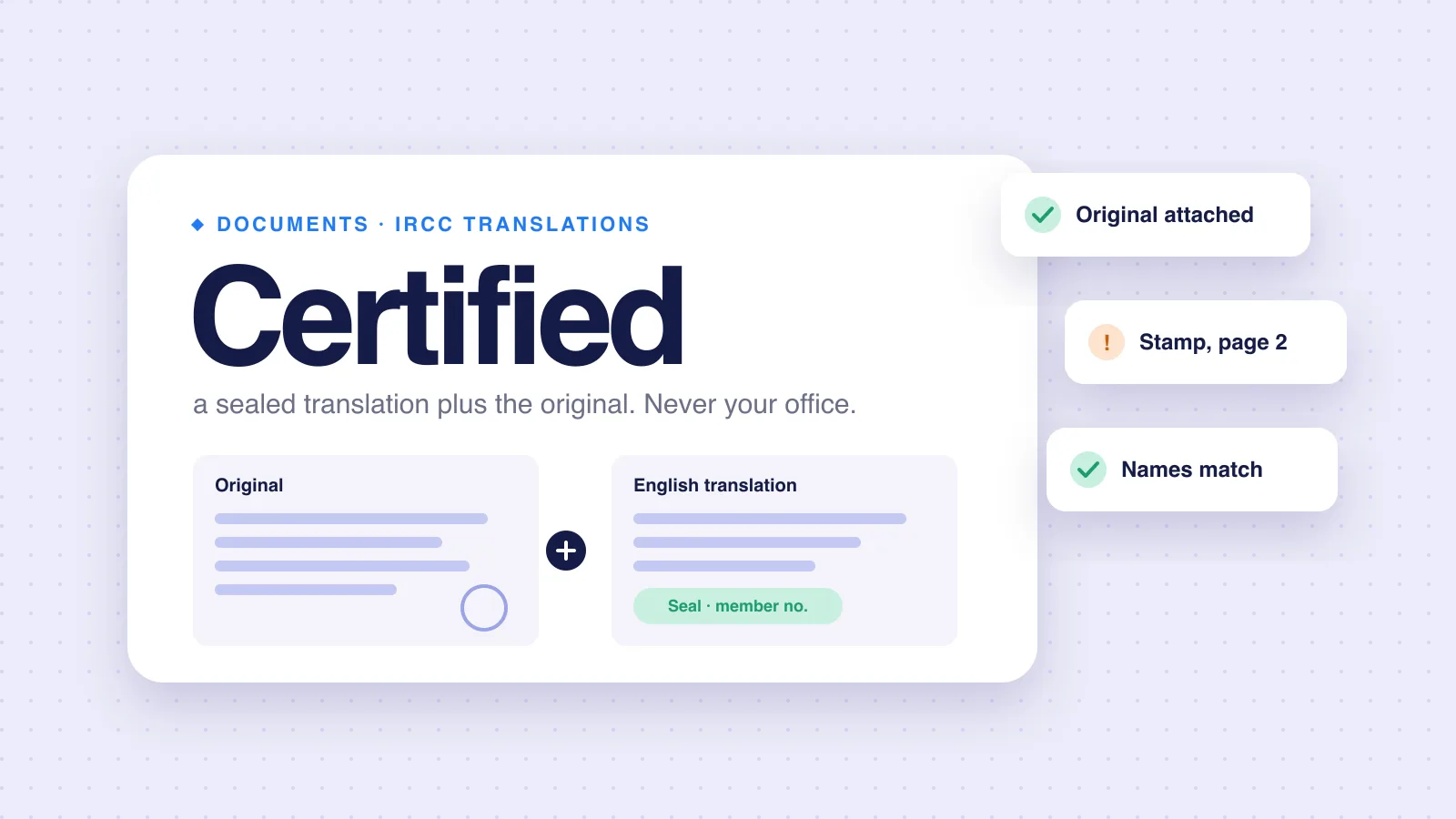
Translations look like a client task. In practice they cause rework at the worst time: a birth certificate translated by a cousin, a marriage certificate with an untranslated stamp, a translation uploaded without the original. Each one surfaces after the invitation, when the 60-day clock is already running.
This guide sets out IRCC translation requirements, who is allowed to translate, and how your practice can check every translation the day it arrives. Everything below comes from IRCC's own pages, checked on 10 November 2026. Read the linked pages for the exact wording before you rely on it.
The rule: English or French, plus the original
"Unless we tell you otherwise, all supporting documents must be in English or French."
That is how IRCC's Help Centre puts it. For Express Entry, IRCC's Apply for permanent residence page sets out what to upload when a document is in another language:
1. The translation
The English or French translation of the document.
2. The original
A scan of the original document, or of the certified photocopy of the original that the translator used.
IRCC notes that a certified photocopy is needed only if the translation was based on one.
Who may translate
IRCC's Express Entry page sets two routes, and draws a hard line around related parties.
Route 1: a certified translator (the preferred route)
IRCC describes a certified translator as a member in good standing of a professional translation association in Canada or abroad. Certification must be shown by a seal or stamp that carries the translator's membership number.
IRCC also says a translator who is still in the process of being certified or accredited does not count as certified.
Route 2: a translator plus an affidavit (when route 1 is not possible)
IRCC says the affidavit route is for when a certified translator cannot do the work. The translator swears before an authorized commissioner or notary that the translation is accurate. IRCC adds that the commissioner or notary must be proficient in English or French. The applicant and their family members cannot take the affidavit, even if they are a lawyer, notary or translator.
Who may not translate
This is the line your practice most needs to know. IRCC says any family member, representative or consultant of the applicant is not permitted to translate documents. That holds even if the person is a lawyer, notary or translator.
For an RCIC practice, that means
- You may not translate a client's documents for their own application.
- Your staff may not either, even if bilingual.
- The client's relatives may not.
Tell clients this in writing at the start of the file, before they spend money on the wrong translator.
Stamps, seals and certified copies
- Stamps and seals. IRCC says all stamps and seals that are not in English or French must also be translated. Check the back of each page and the margins.
- Certified photocopies. Where one is needed, IRCC says the authorized person must sign and date the copy, state their name and position, name the original document, and certify that it is a true copy of the original. In Canada, IRCC lists notaries public, commissioners of oaths and commissioners for taking affidavits. The client and their family members cannot certify their own copies.
- Police certificates. IRCC's police certificate page says to send the original certificate with a translation from a certified translator. More in our police certificate Express Entry checklist.
A check for every translation that arrives
Use the same check every time. It takes a few minutes.
| Check | Pass when |
|---|---|
| Original included | A scan of the original, or the certified copy used, sits with the translation |
| Translator | Seal or stamp shows membership number, or an affidavit is attached |
| Not a related party | Translator is not the client, a family member or anyone at your practice |
| Complete | Every page translated, including stamps, seals and back pages |
| Names match | Spelling of names matches the passport, or the difference is explained |
| Dates match | Dates in the translation match the original and the rest of the file |
| Affidavit route | Used because a certified translator was not available, and sworn before a commissioner or notary |
If a translation fails, send it back with the reason in one line. "Stamp on page 2 not translated" gets fixed. "Please redo the translation" gets a phone call.
When to ask for translations
Translation adds a step and a supplier to every document it touches. Plan for it.
-
At intake
Flag what needs translating
Ask which documents are not in English or French. Flag them on the checklist.
-
Before the invitation
Translate stable documents
Get translations early for documents that will not change, such as birth and marriage certificates and degrees.
-
After the invitation
Translate the reissued ones
Translate documents that will be reissued, such as police certificates and fresh bank letters, once the final versions are in.
Keep the translation and its original together in the file. Our immigration document naming convention shows one way to pair them.
Tell the client early
A short paragraph in your engagement email saves weeks:
Any document not in English or French needs a translation by a certified translator, with a stamp showing their membership number. IRCC does not allow family members or our office to translate. Please send us the original with the translation.
Adjust the wording to your practice. Link IRCC's page so the client sees the rule comes from IRCC.
For the full list of documents that may need translating, see our Express Entry document checklist for consultants. When the translations are in, our guide to the Express Entry application package covers the build.
How rcicaxis handles this
Clients upload originals and translations through the client portal, so both land on the same case. Argus runs 100+ checks on every file and flags blockers and warnings for your review. The final call on whether a translation meets IRCC's rules stays with you.
Questions
Can an RCIC or their staff translate a client's documents for IRCC?
No. IRCC's Express Entry instructions say a family member, representative or consultant of the applicant is not permitted to translate documents, even if they are a lawyer, notary or translator.
What does IRCC mean by a certified translator?
IRCC describes a certified translator as a member in good standing of a professional translation association in Canada or abroad, shown by a seal or stamp with their membership number.
When is an affidavit needed with a translation?
IRCC's Express Entry page says the affidavit route is only for when a certified translator cannot do the work. The translator swears to the translation's accuracy before an authorized commissioner or notary.
Do stamps and seals on the original need translating?
Yes. IRCC says all stamps and seals that are not in English or French must also be translated.
Do police certificates in another language need a translation?
Yes. IRCC's police certificate page says to send the original certificate with a translation from a certified translator.
Sources
- IRCC Help Centre: What language should my supporting documents be in?
- IRCC: Apply for permanent residence through Express Entry (documents in other languages)
- IRCC: How to get a police certificate
IRCC facts checked against the sources above on November 10, 2026. This is practice guidance, not legal advice.