Immigration document naming conventions
One file naming pattern your whole practice can use on every Express Entry file, so anyone can find, check and replace a document in seconds.
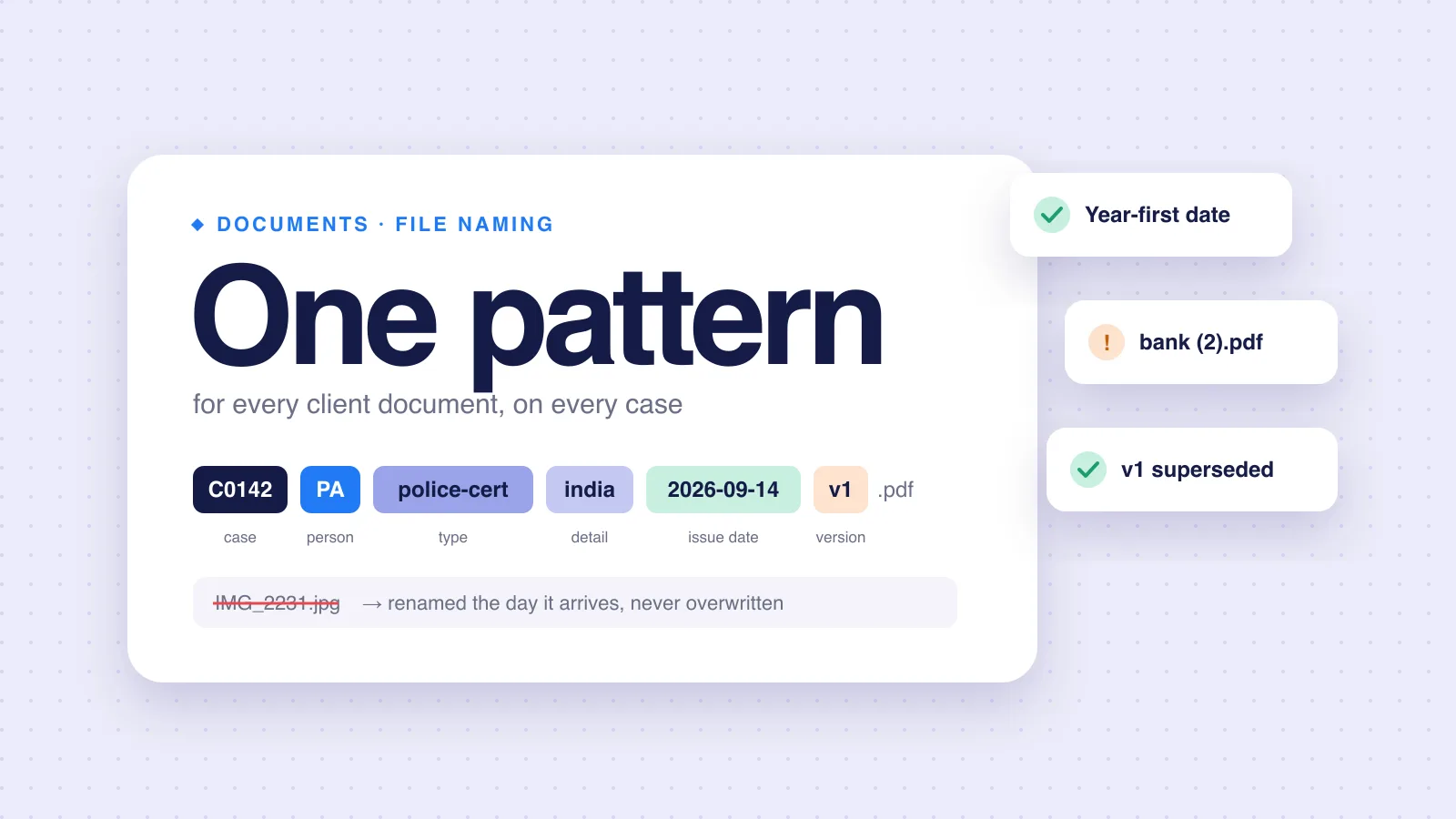
Open a client folder in most practices and you will find "scan1.pdf", "IMG_2231.jpg", "bank (2).pdf" and "FINAL passport new.pdf". Every file has to be opened to know what it is. Every check takes longer. When two staff work the same file, one of them uploads the old version.
An immigration document naming convention fixes this for almost no cost. Here is one you can adopt across your practice this week.
What IRCC says, and does not say
IRCC's Help Centre lists the file types you can upload, and they depend on the online account, such as the APR portal paid representatives use. The page does not set file naming rules.
So naming is a practice decision. Make it once, write it down and apply it on every file.
The pattern
CASE_PERSON_doctype_detail_YYYY-MM-DD_vN.ext
| Part | What it holds | Example |
|---|---|---|
| CASE | Your case or file number | C0142 |
| PERSON | Who the document belongs to | PA, SP, DC1 |
| doctype | One term from your fixed list | police-cert |
| detail | What makes this one different | india |
| Date | Issue date of the document, year first | 2026-09-14 |
| vN | Version, starting at v1 | v1 |
Result: C0142_PA_police-cert_india_2026-09-14_v1.pdf. Anyone on your team can read that without opening it.
Person codes
Pick short codes and never change them.
| Code | Person |
|---|---|
| PA | Principal applicant |
| SP | Spouse or common-law partner |
| DC1, DC2 | Dependent children, oldest first |
| EMP | Employer documents not tied to one person |
Codes matter because IRCC asks for some documents from family members too. Police certificates cover family members aged 18 or older. Medical exams cover family members even if they are not coming. Person codes keep those files apart. Our police certificate Express Entry checklist shows the per-person country list.
A fixed document type list
Free text is where conventions fail. "Police", "PCC", "police clearance" and "criminal record" end up in the same folder. Fix the list.
| Term | Use for |
|---|---|
passport | Passport bio pages |
lang-test | Language test results |
eca | Educational credential assessment |
degree | Diplomas and transcripts |
ref-letter | Employer reference letters |
paystub | Pay stubs |
tax | Tax documents |
bank-letter | Official bank letters for proof of funds |
bank-stmt | Bank statements |
police-cert | Police certificates |
police-proof | Proof of a police certificate request, such as a receipt |
medical | Medical exam confirmation |
marriage | Marriage certificate |
birth | Birth certificate |
translation | Certified translation (detail names the original) |
loe | Letter of explanation |
form | IRCC forms, such as IMM 5476 |
Add terms when you need them. Do not let staff invent them on the fly.
Rules that keep it clean
- Year first in dates. 2026-09-14 sorts correctly. 14-09-2026 does not.
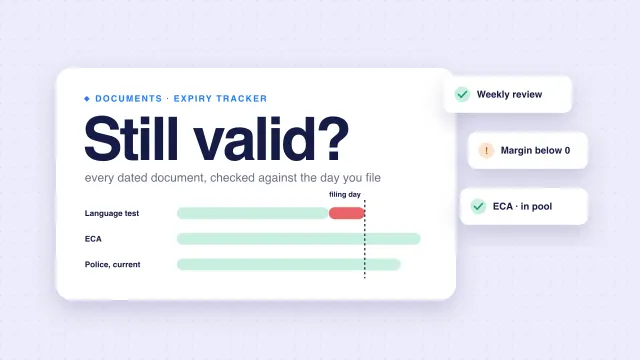
- Use the issue date, not the upload date. You want to see at a glance how old a document is. That matters for language tests, ECAs and police certificates. See tracking immigration document expiry dates.
- Lowercase, hyphens, underscores. No spaces, accents, slashes or symbols. They break in some systems.
- Translations match their originals. Name the translation after the original:
C0142_PA_translation_birth_2026-10-02_v1.pdf. IRCC asks for the translation with a scan of the original, so they should sit side by side. More in IRCC translation requirements. - Versions go up, never overwrite. A replaced bank letter becomes v2. Move v1 to a superseded folder.
- Rename on arrival. The person who logs the upload renames it. Not the person who builds the package six weeks later.
Folder structure
Keep it flat and close to the way you will build the package.
C0142/01-identity/C0142/02-language-education/C0142/03-work/C0142/04-funds/C0142/05-police-medical/C0142/06-family/C0142/07-forms-letters/C0142/99-superseded/
Numbered folders sort in a fixed order. The superseded folder means nothing is deleted by mistake.
Rolling it out
-
Write it on one page
The pattern, person codes and type list.
-
Apply it to new files from today
Every new upload follows the pattern.
-
Rename open files when you next touch them
Do not stop work to rename closed files.
-
Spot-check one file a week for a month
Fix drift early.
Naming at each stage of the file
The same pattern holds from intake to filing. Only the folder changes.
| Stage | What happens to the name |
|---|---|
| Upload | Client file arrives with its own name. Staff rename it the same day |
| Check | Name stays. Status lives in your tracker, not the file name |
| Replace | New file gets the next version number. Old one moves to 99-superseded |
| Translate | Translation gets its own file, named after the original |
| Build | Package files can follow IRCC's checklist slots. Keep your working names in your own folders |
| File | Save a copy of exactly what was uploaded, with the filing date |
This keeps your working copy and your filed copy apart. When IRCC asks for an updated document months later, you can see the old one and its date at a glance.
Common mistakes
- The client's full name in every file. Use the case code. It is shorter and keeps personal details out of file names shared by email.
- Status in the name, like "APPROVED" or "CHECK THIS". Status changes. Names should not.
- Different conventions per staff member. One page, one convention.
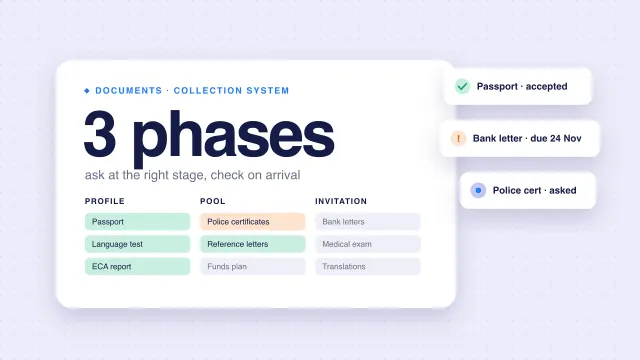
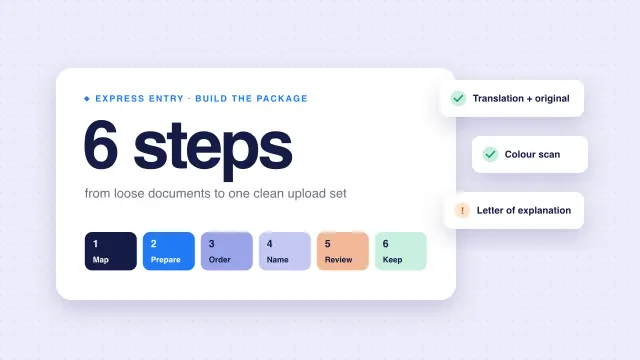
When the files are named, building the upload set is much faster. See how to build an Express Entry application package. If documents still arrive by email and chat, start with our immigration document collection system.
How rcicaxis handles this
Clients upload through the client portal, so documents arrive in one case rather than across inboxes. Compose gives you every document, in order, as one PDF per section, with a cover page, contents and dividers. Argus runs 100+ checks on every file before your review.
Questions
Does IRCC require a file naming format?
IRCC's Help Centre page on file formats lists the accepted file types by account. It does not set file naming rules, so the convention is up to your practice.
What is a good naming pattern for immigration documents?
Case, person, document type, detail, date, version, in that order. For example: C0142_PA_police-cert_india_2026-09-14_v1.pdf. The same order every time is what makes it work.
Should we rename files the client uploads?
Yes, when they arrive. Client file names like scan1.pdf or IMG_2231.jpg tell you nothing. Rename on arrival and keep the original upload untouched in an archive folder if your policy needs it.
How do we handle a replaced document?
Raise the version number and move the old file to a superseded folder. Never overwrite. You want to see what was replaced and when.
Sources
- IRCC Help Centre: accepted file formats by online account
- IRCC: Apply for permanent residence through Express Entry
IRCC facts checked against the sources above on November 10, 2026. The naming convention itself is practice guidance, not an IRCC rule.