Immigration document collection: a system for RCICs
A document collection system for RCIC practices: ask for the right documents at the right stage, check them on arrival and follow up on a fixed schedule.
Most Express Entry files do not stall on eligibility. They stall waiting for a bank letter, a police certificate or a readable scan of a passport page. You send the list, the client sends half of it by email, and the rest arrives in pieces over chat and three reply threads.
The fix is an immigration document collection system that every person in your practice runs the same way on every file. Here is one that fits a solo or 2-3 person practice.
Why immigration document collection breaks down
- The client gets one long list with no order to work through it.
- Requests have no due date, so nothing feels urgent until the invitation lands.
- Files arrive by email, chat and shared drives, so nobody knows what is in.
- Checks happen at final review, so a wrong document is found weeks late.
- Each staff member follows up in their own way, or not at all.
Each of these is a process gap. None needs a better client. It needs a better system. The six steps below close one gap each.
Step 1: Split the list into phases
Do not send everything on day one. Group requests by when you need them.
| Phase | When | What to ask for |
|---|---|---|
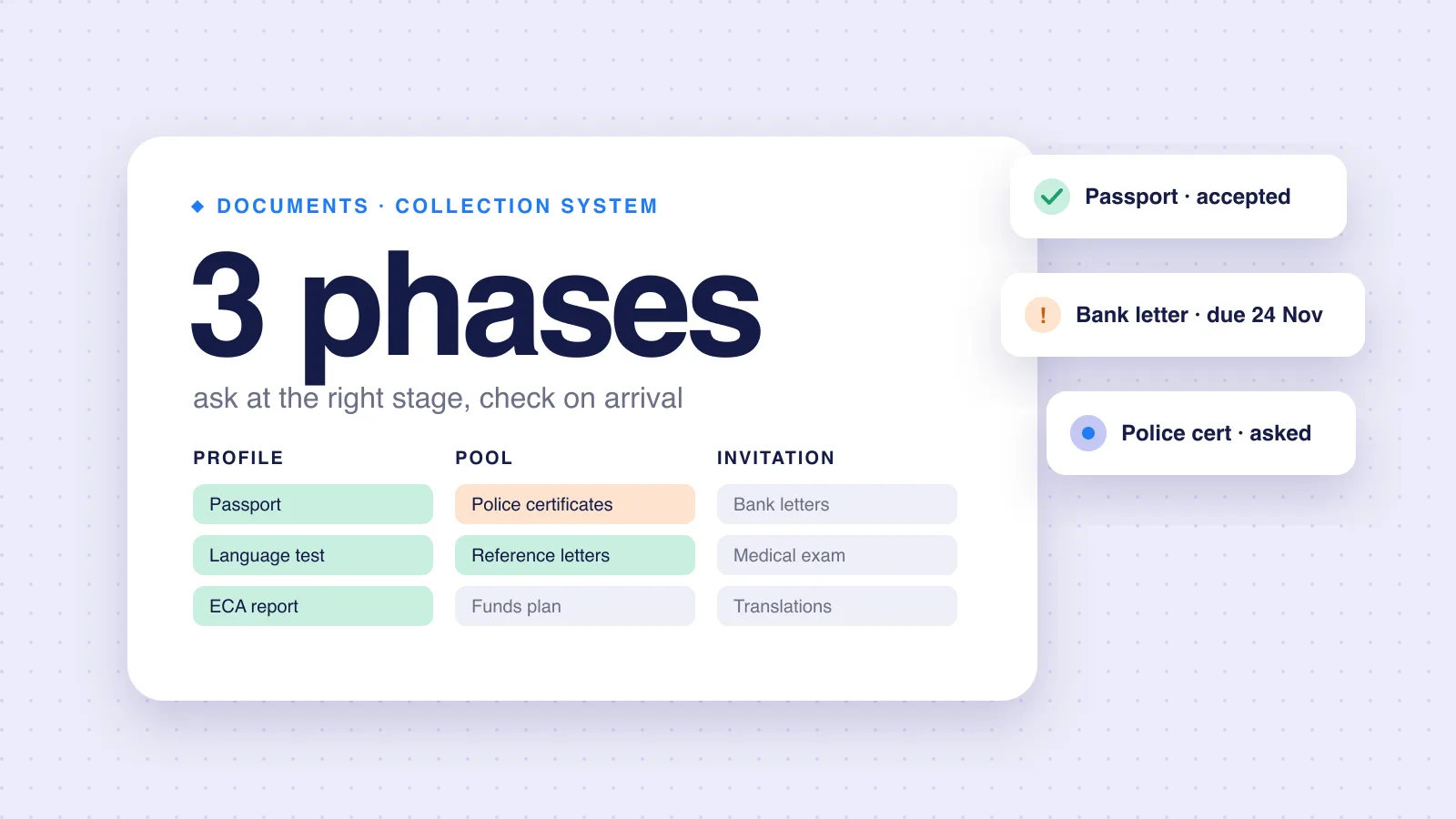
| Profile | At engagement | Passport, language test results, ECA report or Canadian credential, work history, job offer if any |
| Pool | Once the profile is in the pool | Police certificates, employer reference letters, a plan for proof of funds |
| Invitation | Within days of the ITA | Fresh bank letters, medical exam, remaining civil documents, translations |
IRCC's Express Entry documents page lists what a candidate may need. Use it as the base of your list. Then add what intake tells you: a spouse, children, countries lived in. Our Express Entry document checklist has the full list.
Police certificates sit in the pool phase for a reason. IRCC suggests asking for them as soon as the profile is in the pool. See our guide to police certificates for Express Entry.
Step 2: Give every request an owner and a date
- One staff member owns collection on each file.
- Every request gets a real date, never "as soon as possible".
- Dates count back from the deadline that matters. After an invitation, IRCC gives 60 days to submit.
- Leave a buffer for checking, translation and redo. Do not plan to receive the last document on day 59.
Write the dates into the request itself. "Please upload your bank letter by 24 November" gets a different response than "please send your bank letter".
Step 3: One place to upload
Email attachments get lost, renamed or saved twice. Chat apps compress images. Shared drives fill with "scan1.pdf".
-
Pick one upload channel for all clients
The same channel on every file, for every staff member.
-
Say so in writing
Your engagement email tells the client that documents go there. See secure file sharing with clients for choosing the channel.
-
Move strays the same day
If a client emails a document anyway, move it into the channel that day.
-
Rename on arrival
Rename each file when it arrives, using one convention. Our document naming guide has a pattern you can copy.
One channel gives you one answer to "what do we have?".
Step 4: Check on arrival, not at the end
A two-minute check when a file lands saves a week later. Use the same checks every time.
| Check | What to look for |
|---|---|
| Readable | All four corners, every page, no glare, no cropped stamps |
| Right person | Name matches the passport, including spelling and order |
| Right document | For example, IRCC accepts only the IELTS General Training option for Express Entry |
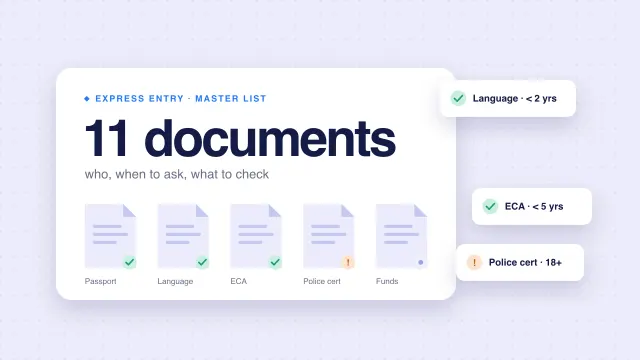
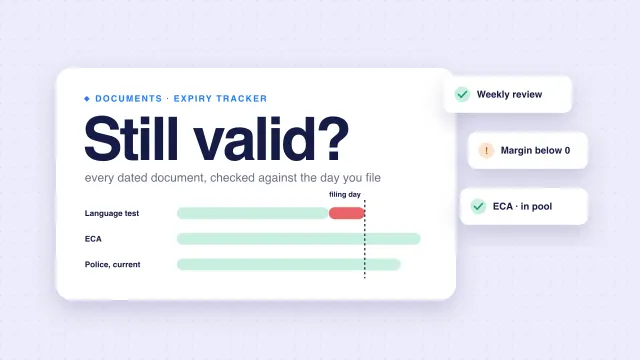
| Dates | Language results under 2 years old, ECA under 5 years old, at profile and at submission. Track them with an expiry tracker |
| Language | Anything not in English or French needs a translation. See IRCC translation requirements |
| Complete | Every page, including blank backs if they carry stamps |
Mark each document as accepted or "needs redo" with a one-line reason. The client gets the reason, not a vague "please resend".
Step 5: Follow up on a fixed schedule
Ad hoc follow-up is where files drift. Pick a cadence and use it on every file.
-
Due date − 2 days
Reminder
A short note naming the document and the date.
-
Due date
Reminder
The same note, on the day it is due.
-
Due date + 3 days
Phone call
If it is still missing, call.
-
After every touch
Note on the file
So the next person knows where it stands.
Keep the message short and specific:
Hi [name], we still need your police certificate from [country]. It was due on [date]. If you have applied, please upload the receipt so we can track it.
Name the document, the date and the next action. Nothing else.
Step 6: Keep one status view
Every file should answer five questions at a glance:
Requested
What we asked for and when.
Received
What came in.
Checked
What passed the arrival check.
Needs redo
What came back and why.
Missing
What is overdue.
A spreadsheet works for a few files. It gets hard once you have many files in the pool at once, and once two people edit the same sheet. See spreadsheet vs case management software for where the line falls.
A one-page collection policy
Write the system down. Half a page is enough:
- Which documents are asked for in which phase.
- Where clients upload.
- Who checks, and within how many working days.
- The follow-up cadence.
- What happens when a document stays missing.
New staff read it on day one. Clients get a short version in the engagement email. Our client intake checklist covers what to ask before you build the first list.
How rcicaxis handles this
Clients use the client portal to fill in their own details and upload their own documents, so everything lands in one place under your practice's name. Argus runs 100+ checks on every file and flags blockers and warnings before your review. Deadline rules are tracked per pathway, with reminders. Your staff talk in case chat and keep staff-only notes on the file. Every new practice starts with 3 free cases.
Questions
When should a consultant ask an Express Entry client for documents?
In phases. Ask for profile documents at engagement, start long-lead items like police certificates once the profile is in the pool, and collect the rest after the invitation. IRCC gives 60 days to submit after an invitation.
How do I stop clients sending documents by email and chat?
Pick one upload channel, say so in writing at engagement, and move anything that arrives elsewhere into it the same day. One channel means one place to check what is in.
Should staff check documents when they arrive or at final review?
On arrival. A blurry scan or the wrong test type found on day two costs a message. Found in week seven, it can cost the deadline.
How often should we follow up on missing documents?
Set a fixed cadence for the whole practice, for example a reminder before the due date, one on the day and a call a few days after. The same rhythm on every file makes follow-up a routine, not a judgment call.
Sources
- IRCC: Immigrate through Express Entry, documents
- IRCC: Express Entry, police certificates
- IRCC: Apply for permanent residence through Express Entry
- IRCC: Express Entry, language test results
- IRCC: Express Entry, educational credential assessment
- IRCC Help Centre: What language should my supporting documents be in?
IRCC facts checked against the sources above on November 10, 2026. This is practice guidance, not legal advice.