Immigration client onboarding: the first 48 hours
What a small RCIC practice can get done in the first two days after a client says yes: the agreement the Code requires, the IRCC paperwork, the document request and the first written update.
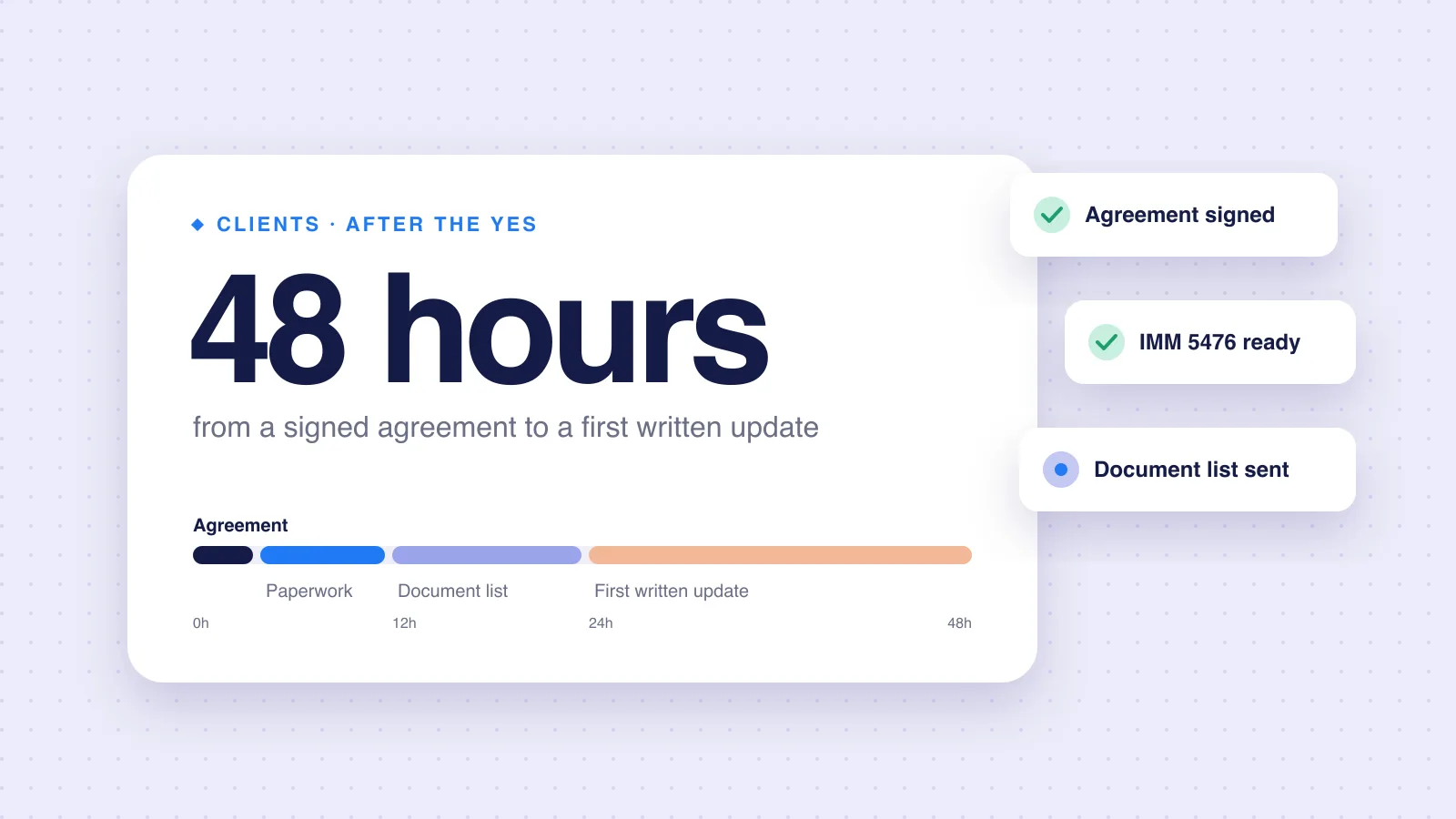
The client said yes on the consultation call. Now there is a gap. If nothing happens for a week, the client can go quiet, and the documents you need arrive in pieces for months. The first 48 hours decide how much chasing the rest of the file needs.
This immigration client onboarding plan is for an RCIC running a solo or 2-3 person practice on Express Entry files. The 48-hour window is our target. The Code steps inside it are rules.
The 48-hour immigration client onboarding plan
Hour 0 to 4: the service agreement
The Code sets the order. Section 24(1) says you must enter into a written service agreement before providing any services, or after an initial consultation, before providing any additional services.
Before you send it
Section 24(2) lists what to do first:
- Confirm the client's full name, home address, personal phone and email if any, and business contact details if applicable. The Code says to seek corroboration "if possible", so match these against the passport or an ID.
- Give the client a draft of the agreement.
- Check whether the client already has a service agreement with another authorized representative. If so, confirm it was completed or terminated in writing.
What goes in it
Section 24(3) lists 26 required items, (a) to (z). Do not rebuild your template from memory. Check it against the Code once a year. A few items are worth a second look, because they shape the rest of onboarding:
| Item | What the Code requires | Why it matters now |
|---|---|---|
| 24(3)(e) | Names of the people likely to assist you | Name your assistant now, not later |
| 24(3)(g) | An itemized list of services tailored to the client | Sets the scope you will update against |
| 24(3)(h) | Estimated time frames | Sets expectations you must keep |
| 24(3)(q) | Your confidentiality obligation and how you will maintain it | Decide how files will travel before the first upload |
| 24(3)(t) | A statement that you will give timely status information | Commits you to the update routine |
| 24(3)(y) | What happens to the file if you cannot continue | A real risk for a solo practice |
Section 24(4) asks you to keep a signed copy and give one to the client.
Hour 4 to 12: IRCC paperwork and the file
-
Representative form
If you will represent the client with IRCC, prepare the Use of a Representative form (IMM 5476). IRCC's Express Entry pages link it, and IRCC asks to be told if the client changes representative.
-
Open the case file
One folder or one case per client. Name it the same way every time. Our guide to document naming conventions has a pattern.
-
Set the deadlines you already know
Passport expiry, language test date, work permit expiry. If the client already has an invitation, the 60-day window is running now.
Hour 12 to 24: the document request
Ask for everything at once, as a list tailored to this client. A generic list makes the client guess, and guessing produces the wrong documents.
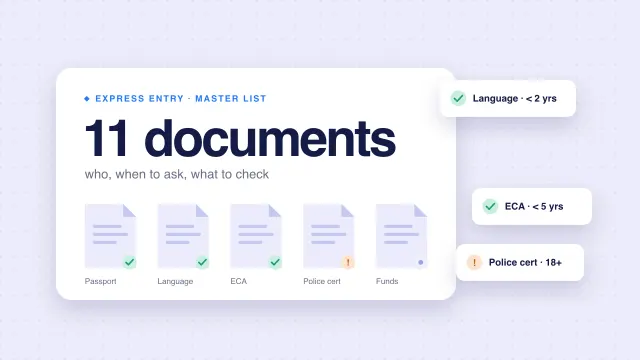
IRCC's Express Entry documents page lists what may be needed: passport or travel document, language test results, an educational credential assessment or proof of Canadian education, a written job offer if any, proof of work experience, a trade certificate if any, proof of funds, police certificates and a provincial nomination if any.
Make the request concrete:
- One line per document, per person (applicant, spouse, dependants).
- What "good" looks like for each one. For example, a bank letter on letterhead with balances and a 6-month average.
- Which documents take longest. Police certificates from abroad belong at the top of the list.
- A due date for the first batch.
- Where and how to send them. Pick one secure channel. See secure file sharing with clients.
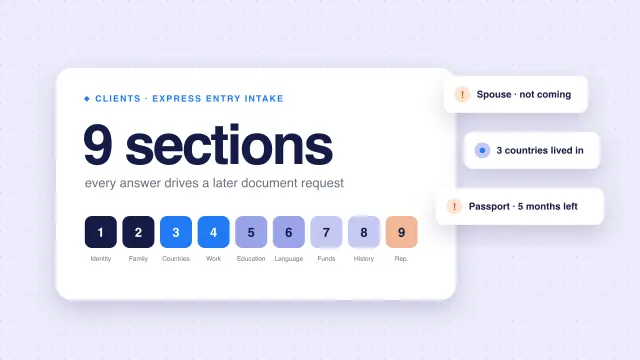
Our Express Entry document checklist has the full list, and the intake checklist covers the questions to ask before you build it.
Hour 24 to 48: the first written update
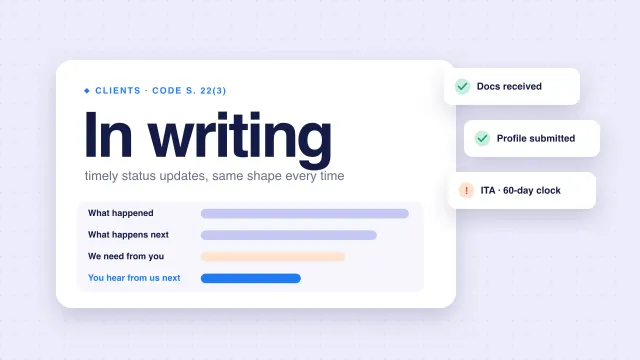
Close the window with a short written update. It sets the pattern for the whole file, and it meets the duty in section 22(3) of the Code to keep the client informed in writing.
Welcome. Here is where your file stands.
Done: service agreement signed on [date].
Next: we review your documents as they arrive.
We need from you: the items on your list, first batch by [date].
You will hear from us: when the first batch is reviewed, or by [date].
Then follow the routine in our guide to client status updates.
Two Code items that are easy to forget
The service agreement has two items that are about paperwork you hand over, not words in the agreement:
A copy of the Code for the client
Section 24(3)(x) requires a statement that you have provided a copy of the Code to the client. Send it with the draft agreement, so the statement is true when they sign.
A copy of the Code for your assistant
Section 38(1)(b) requires that anyone who assists you is given a copy of the Code and is familiar with its contents. If a new assistant starts on this file, do it before they open it.
What to skip in the first 48 hours
Detailed CRS strategy before you have the documents. You will redo it.
Long welcome packs. One clear list beats ten pages.
Asking for documents in several emails. Each extra email is one more thing for the client to lose.
How rcicaxis handles this
rcicaxis covers the document part of onboarding. You invite the client to a client portal under your firm's name, where they fill in their own details and upload their own documents against a list of what applies to them. Their deadline sits on the first screen they see, and questions go into one message thread on the case. The service agreement and the IMM 5476 stay with you and your own tools.
Questions
What must be in an RCIC's service agreement?
Section 24(3) of the Code lists the required contents, from your name and registration number to fees, the confidentiality statement, the complaint-handling procedure and what happens to the file if you cannot continue. Read the full list in SOR/2022-128 before you finalize your template.
Can I start work before the service agreement is signed?
Section 24(1) says a licensee must enter into a written service agreement before providing any services or, after an initial consultation, before providing any additional services.
What do I need to confirm about the client before the agreement?
Section 24(2) says to confirm the client's full name, home address, personal phone and email if any, and business contact details if applicable, seeking corroboration if possible. It also asks you to check whether they already have an agreement with another authorized representative.
Why 48 hours?
It is a target we suggest. The Code sets no such window. A client who has just said yes is paying attention, so the first two days are a good moment to ask for documents.
Sources
- Code of Professional Conduct for College of Immigration and Citizenship Consultants Licensees (SOR/2022-128)
- IRCC: Apply for permanent residence through Express Entry
- IRCC: Express Entry, after you apply
- IRCC: Immigrate through Express Entry, documents
Code text and IRCC facts checked against the sources above on November 10, 2026. This is practice guidance, not legal advice.