Express Entry ITA checklist for your practice
What your practice does in the 60 days after a client's invitation to apply: re-check every dated document, collect what is left, build the package and file with time to spare.
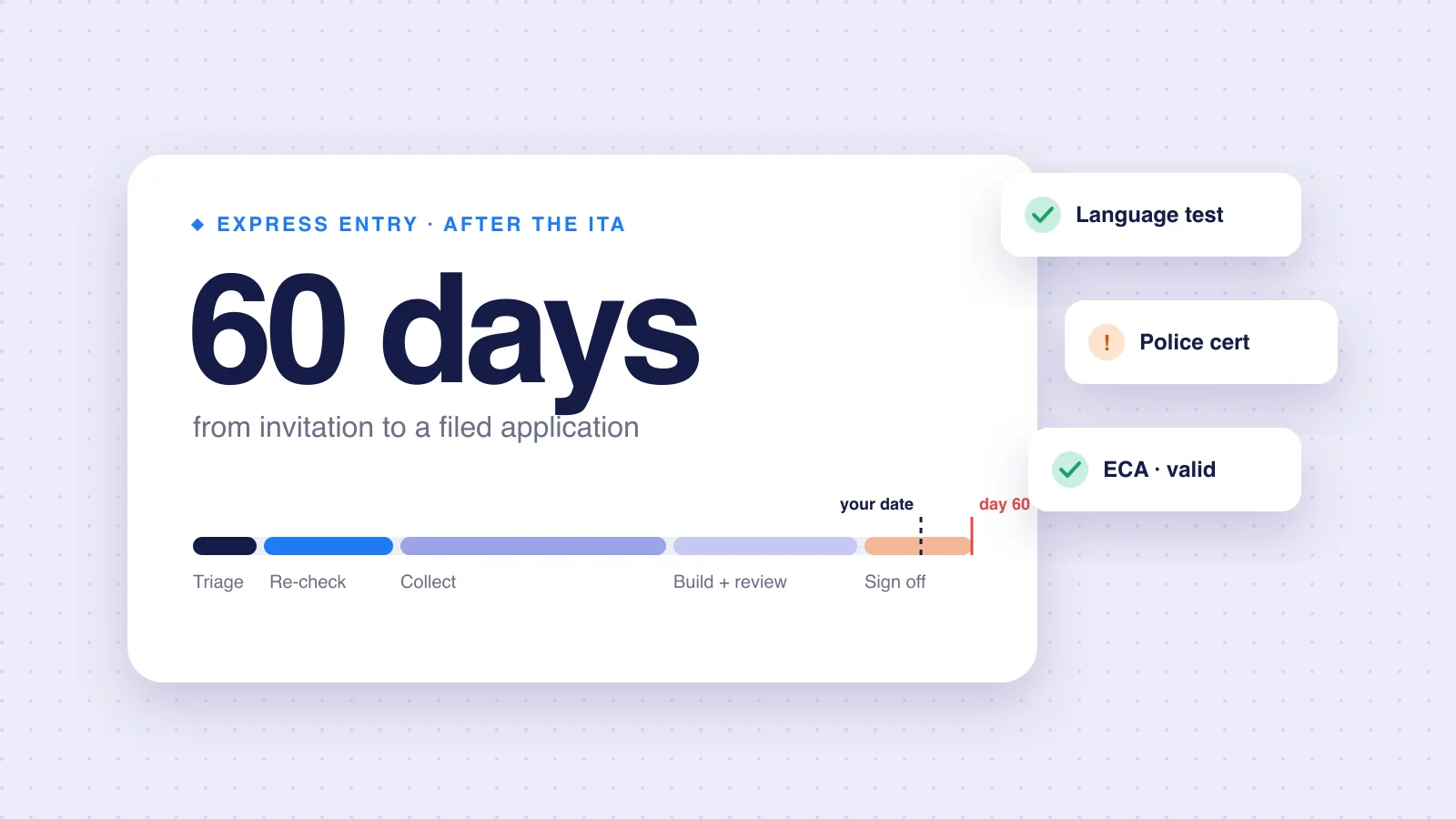
An invitation to apply is good news with a hard deadline. The client has 60 days. In that time your practice has to re-check everything from the profile, collect what is still missing, build the package, review it and file. If two invitations land in the same week, the deadlines stack.
This is a checklist for the practice side of those 60 days. IRCC facts were checked on 10 November 2026 on the pages listed in the sources. The weekly plan is a practice suggestion, not an IRCC rule.
The deadline
IRCC says the invitation is valid for 60 days only. The Ministerial Instructions set the window as ending on the 60th day after the invitation is issued. If no application is made in time, IRCC says the invitation expires and the profile is removed from the pool. The client would need a new profile to be considered again.
Write both dates on the file the day the invitation arrives: the IRCC last day, and your own filing date at least a week earlier.
Day 1-3: Triage
- Record the invitation date and the last day to apply.
- Set an internal filing date with buffer.
- Assign one staff owner and confirm the consultant who will sign off.
- Tell the client: what happens next, what you need, and by when.
- Start the online application so the personalized document checklist appears. IRCC says it shows once the form is completed.
Week 1: Re-check everything dated
The profile may have sat in the pool for months. Dates that were fine then may not be now.
| Item | IRCC rule | Check |
|---|---|---|
| Language test results | Less than 2 years old at submission | Still valid on your planned filing date? |
| ECA | Less than 5 years old at submission | Still valid on your planned filing date? |
| Passport | IRCC advises renewing if it expires within 6 months of applying | Renewal needed? |
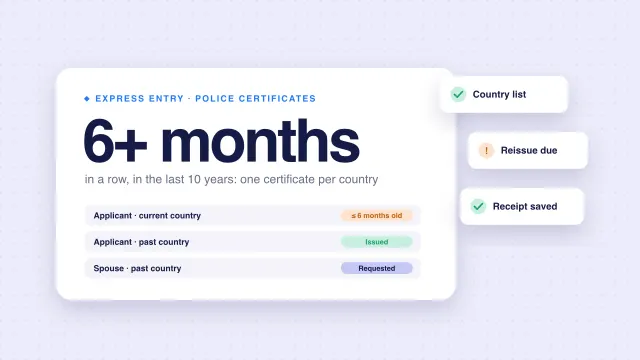
| Police certificate, current country | Issued no more than 6 months before submission | Reissue needed? |
| Proof of funds | Funds available when applying and at visa issuance | Fresh letters needed? |
IRCC says it will refuse an application made with expired language results or an expired ECA. Catch these in week one, not week seven. If the client retakes a test, read the new scores with our IELTS to CLB converter.
Also confirm the facts behind the profile:
- Still with the same employer? Same hours?
- Any new family members, or a change in marital status?
- Any new address or country of residence?
- Job offer or nomination still valid, if claimed?
Weeks 1-4: Collect what is left
-
Medical exam
Express Entry uses an upfront exam, after the invitation and before applying. IRCC suggests booking it as close as possible to the apply date. It also says family members must be examined even if they are not coming. Do not book more than one appointment, IRCC says.
-
Police certificates
Every qualifying country for the client and family members 18+. If one will be late, IRCC asks for a letter of explanation and proof of best effort in that country's field. See our police certificates guide.
-
Proof of funds
Fresh official letters, if the client needs proof of funds. See the proof of funds guide.
-
Reference letters
Current and dated, matching the profile. See the reference letter checklist.
-
Translations
For every document not in English or French. See IRCC translation requirements.
-
Forms
IMM 5476 if your practice represents the client. IRCC says it deals only with paid representatives in good standing with their regulatory body. Add other forms the checklist asks for, such as IMM 5409 for common-law partners. Our IMM 5476 guide walks through it.
Weeks 4-6: Build and review
- Fill in the application form, including IRCC's questions on previous IRCC and Express Entry applications.
- Map each document to its checklist slot.
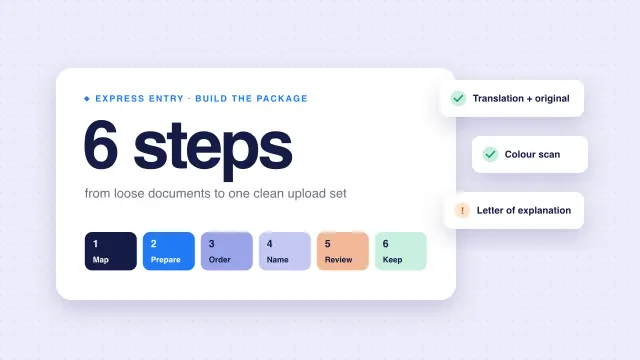
- Build each upload. See how to build an Express Entry application package.
- Review the built package against the form and the profile: names, dates, work periods, family members.
- Re-check every dated item against your filing date, again.
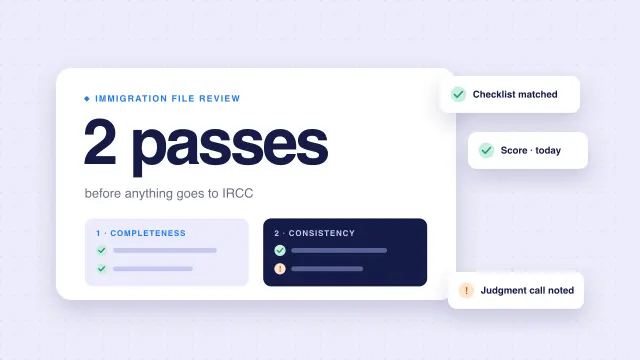
A second reviewer catches what the builder misses. Our pre-submission review checklist covers the full review.
Week 7: Sign off and file
- Consultant sign-off on the final package.
- Client confirms the form answers are true and complete.
- Fees ready: IRCC lists the processing fee, the biometrics fee and the right of permanent residence fee.
- Every mandatory field filled and every required document included. IRCC says you can only submit then.
- Filed. If you represent the client, check the application shows in your IRCC APR portal account. Save the confirmation and the exact files uploaded.
After filing
- Send the client a copy of what was filed and the confirmation.
- Keep watching dated items. IRCC may ask for updated documents during processing, and medical results are valid for 12 months.
- Remind the client that proof of funds must still be in place when a permanent resident visa is issued, if it applied.
Keep the 60 days visible
A file can sit for two weeks while another one is urgent, and nobody notices until the buffer is gone. Keep every open invitation in one view, sorted by days left, with who owns it and what is still missing. Review that view at the start of every week. Our guide to Express Entry case management covers the whole file, from profile to submission.
How rcicaxis handles this
Deadline rules are tracked per pathway, with reminders, so each open file's dates stay in front of your team. Clients upload the remaining documents through the client portal. Compose gives you every document, in order, as one PDF per section, with a cover page, contents and dividers. Argus runs 100+ checks on every file and flags blockers and warnings before your sign-off. You file with IRCC yourself.
Questions
How long does a client have to apply after an Express Entry ITA?
60 days. The Ministerial Instructions set the window as ending on the 60th day after the invitation is issued. If no application is made, IRCC says the invitation expires and the profile is removed from the pool.
When should the medical exam be done?
Express Entry uses an upfront medical exam, done after the invitation and before applying. IRCC suggests getting it as close as possible to the date the client applies online, and says results are valid for 12 months.
What happens if language results or the ECA expire before filing?
IRCC says it will refuse an application made with expired language test results or an expired ECA. Results must be under 2 years old and the ECA under 5 years old at submission.
Which fees are paid with the application?
IRCC's Express Entry apply page lists the processing fee, the biometrics fee and the right of permanent residence fee.
Sources
- IRCC: Apply for permanent residence through Express Entry
- Ministerial Instructions respecting the Express Entry system
- IRCC: Medical exam requirements for permanent residents
- IRCC: Express Entry, language test results
- IRCC: Express Entry, educational credential assessment
- IRCC: Express Entry, police certificates
- IRCC: Express Entry, proof of funds
- IRCC: Use of a Representative (IMM 5476)
IRCC facts checked against the sources above on November 10, 2026. This is practice guidance, not legal advice.