Immigration file review checklist before you submit
A two-pass review an RCIC can run on every Express Entry file before submission, built on IRCC's own completeness check and your duties under the Code of Professional Conduct.
You have 60 days from the invitation, a client who uploaded files in three batches, and one chance to submit a complete application. The review before submission is where you catch what slipped. Done from memory, case by case, it changes with the day you are having. This immigration file review checklist turns it into the same pass every time. It is one step in Express Entry case management, after the package is built.
It is built on two sources. The first is IRCC's own completeness check. The second is the Code of Professional Conduct, which makes the file your responsibility. Section 22(2) says the licensee must ensure "all the necessary documents and information are, as applicable, properly prepared, signed and submitted."
Why two passes
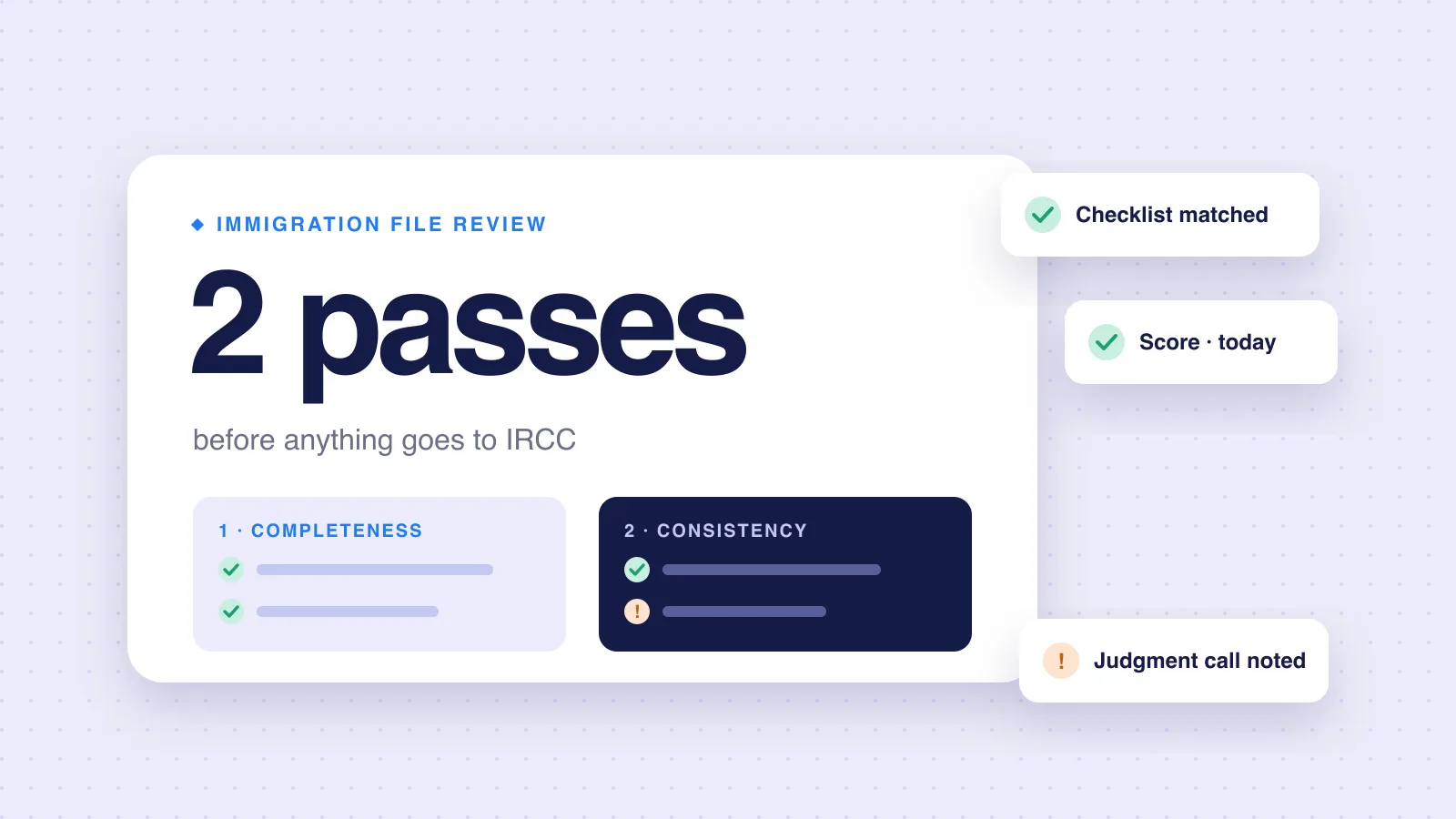
One person reading a file top to bottom tends to see what they expect. Split the review in two:
| Pass | Who | Question it answers |
|---|---|---|
| Completeness | You or your assistant | Is every required item here, readable and in date? |
| Consistency | You, the licensee | Does the file tell one true story that matches the profile? |
If an assistant runs the first pass, the Code still puts the result on you. Section 38(2) says a licensee "must supervise and assume professional responsibility for any work done by a person who assists" them.
Pass 1: completeness
IRCC says that when it receives an application, it checks the form is completely and correctly filled out, the fee is paid, the requirements are met and all documents are included. Mirror that. Our IRCC incomplete application guide covers what that check looks for and what a rejection costs the client.
Forms and fees
- Every field on the online form answered. No blanks where a "none" or "not applicable" belongs.
- Processing fee and any other fees paid, receipts saved to the file.
- The Use of a Representative form (IMM 5476) prepared and signed, if you represent the client.
Documents against IRCC's checklist
- Every line on the personalized checklist IRCC generated has a matching upload.
- Each scan is clear, complete and in a format IRCC accepts. Open each at full size.
- Each document not in English or French has the original, the translation, and a certified translator's stamp or an affidavit.
- Translations were not done by a family member or by you. IRCC says family members and representatives cannot translate the documents.
Dates, measured against the submission day
- Police certificate for the current country issued no more than 6 months before submission.
- Other police certificates issued after the client's last stay of 6 months or more in that country.
- Any missing certificate covered by a letter of explanation and proof of the attempt.
- Language test results still valid on the submission day.
- Work permit dates checked. IRCC warns that if the work permit expires before the client applies, the score may drop.
- Passport valid. See tracking document expiry dates.
Funds and work history
- Proof of funds included, unless the client is in the Canadian Experience Class or is authorized to work in Canada with a valid job offer.
- Each bank letter on letterhead, showing debts, account numbers, opening dates, current balances and 6-month averages.
- No borrowed funds and no property equity counted. IRCC rules out both.
- Each job claimed has a reference letter showing duties, dates and salary.
Pass 2: consistency
This pass is judgment work. It belongs to the licensee.
- Profile against application. Every claim that earned points in the profile is supported by a document in the application.
- Score recalculated today. IRCC tells candidates to recalculate if their situation changed. If the score is now below the round's cut-off, IRCC says to decline, and that it will refuse the application if submitted anyway.
- Names and dates match across passport, certificates, letters and forms.
- Address and travel history cover the full period, with no gaps that a police certificate should fill.
- Family members are all declared, and the same people appear on every form.
- Changes reported. If family composition, job, job offer, language results or credentials changed, IRCC asks for an update.
- Nothing untrue. IRCC warns that untruthful answers can lead to refusal, a finding of inadmissibility or a 5-year bar.
For the mistakes behind each line, see Express Entry application mistakes RCICs can catch.
Record your judgment calls
Some flags are not errors. A gap in the address history may have a reason. A police certificate may be late for reasons outside the client's control. For those, IRCC accepts a letter of explanation in some cases. For police certificates, it asks for the letter plus proof of the attempt, such as a receipt or tracking number.
For each judgment call you accept, write one line in the case file:
What you saw
The flag, in plain words.
Why you accepted it
The reason, as you judged it.
What you included
Anything, if any, you added to explain it.
That note helps if IRCC asks a question later. It also helps the next person who opens the file, including you, six months from now.
After the review
-
Record the review
Who ran each pass and on what date, in the case file.
-
Fix and re-run
Fix every item that failed. Re-run the pass that found it.
-
Submit in the window
Submit before the 60-day invitation window closes. Our Express Entry ITA checklist plans those 60 days week by week.
-
Tell the client in writing
Section 22(3)(a) of the Code requires you to notify the client when a document or information has been submitted or received on their behalf. See client status updates.
Keep the checklist close to the files
A checklist kept in a separate document drifts. Keep it beside the files it checks, so each tick points at a real upload. If you build the final package by hand, our Express Entry application package guide covers order and naming. Our Express Entry document checklist covers what to collect in the first place.
How rcicaxis handles this
Argus runs the mechanical part of pass 1 for you: 100+ checks on every file, date and cross-reference in an Express Entry case. Each flag lands as a blocker, a warning or a judgment call, with the file and the reason beside it. Argus never advises or decides. Pass 2 stays yours, and nothing goes out without your sign-off.
Questions
What does IRCC check first when an Express Entry application arrives?
IRCC says it makes sure the application is completely and correctly filled out, the processing fee is paid, the requirements are met and all documents are included. If the application is not complete, IRCC rejects it and refunds the fees.
Can my assistant do the pre-submission review?
They can do the preparation. Section 38(2) of the Code says a licensee must supervise and assume professional responsibility for work done by a person who assists them. The final review and sign-off stay with you.
When should the review happen?
Run it close to the submission date. Police certificate dates, language test validity and work permit expiry are all measured against the day you submit, so an early review can go stale.
Do I need to tell the client when the application is submitted?
Yes. Section 22(3)(a) of the Code requires the licensee to notify the client in writing when a document or information has been submitted or received on their behalf.
Sources
- IRCC: Express Entry, after you apply
- IRCC: Apply for permanent residence through Express Entry
- IRCC: Express Entry, police certificates
- IRCC: Express Entry, proof of funds
- Code of Professional Conduct for College of Immigration and Citizenship Consultants Licensees (SOR/2022-128)
IRCC facts and Code sections checked against the sources above on November 10, 2026. This is practice guidance, not legal advice.