Express Entry application mistakes RCICs can catch
The errors IRCC itself names as reasons an Express Entry application is rejected or refused, and the check your practice can run to catch each one before you submit.
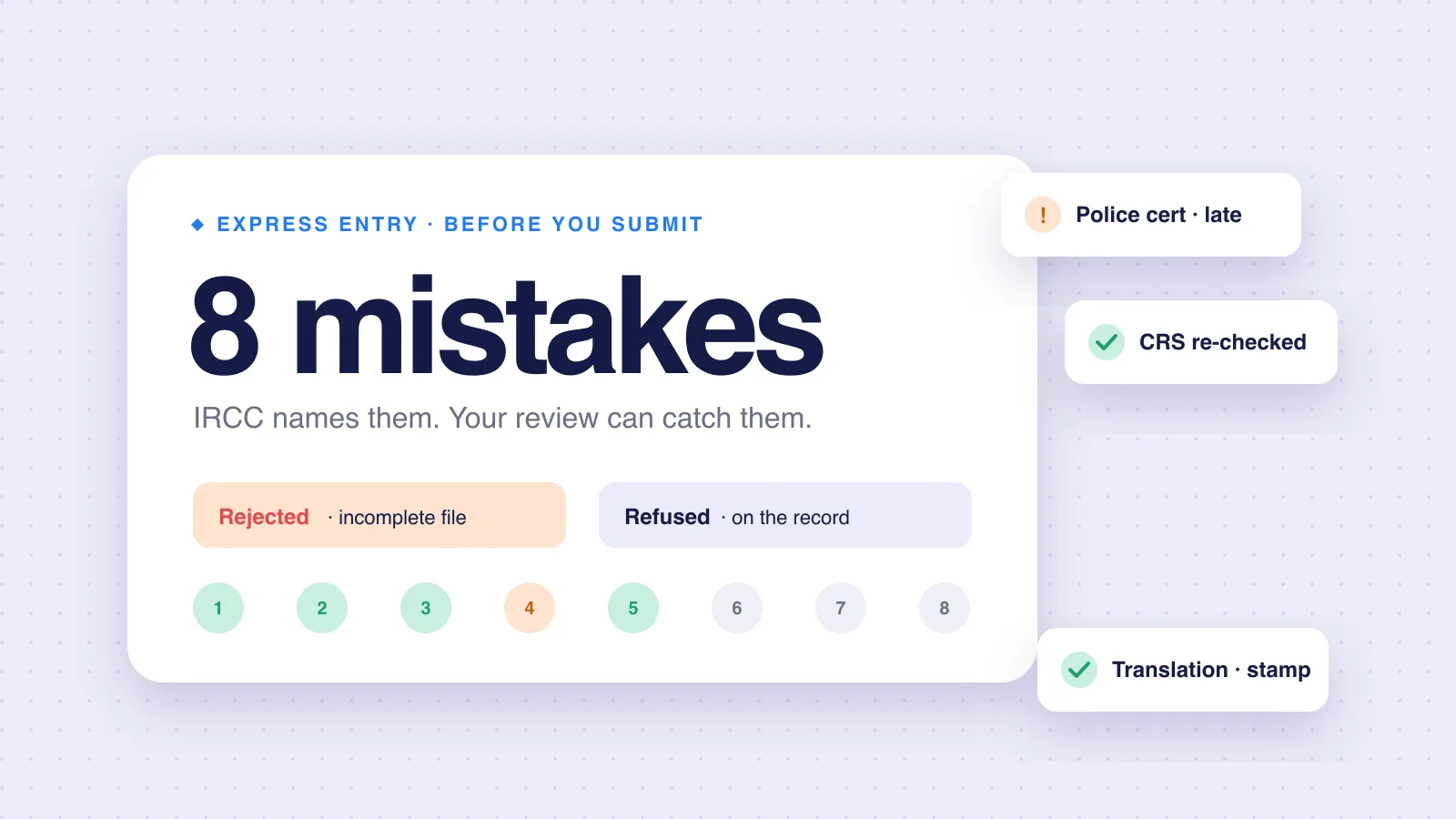
Most Express Entry files that go wrong do not go wrong on eligibility. They go wrong on a missing scan, a late police certificate or a score that slipped after the invitation. IRCC is clear about what happens next: an incomplete application is rejected, and some errors lead to refusal.
This guide is for the RCIC who signs the file. It lists the Express Entry application mistakes IRCC itself names, and a check your practice can run on each one. Everything below comes from IRCC's own pages, linked at the end. It is practice guidance, not legal advice. When a rule matters to a specific file, read the source page for that file.
The two outcomes you are trying to avoid
IRCC uses two different words, and they cost the client different things.
| Outcome | What IRCC says | What it costs |
|---|---|---|
| Rejected as incomplete | "If your application is not complete, we'll reject it and refund your processing fees." | The invitation is spent. The client needs a new profile and a new draw. |
| Refused | The decision turns on eligibility and admissibility. Untruthful answers can also lead to refusal. | A decision on the record. In some cases, fees are not refunded. |
When IRCC receives the application, it checks four things. Your review should check the same four.
1
The form is fully and correctly filled out.
2
The fee is paid.
3
The requirements are met.
4
All documents are included.
Eight Express Entry application mistakes, and how to catch them
1. A document on the checklist is missing
IRCC's system builds a personalized document checklist once the online form is done. Its general guidance says a missing required document can mean the application is delayed, returned or refused. For Express Entry, an incomplete file is rejected.
Check: print the checklist IRCC generated for this client. Tick each line against an actual uploaded file, not against your memory of the case.
2. Scans that cannot be read, or the wrong format
IRCC asks for "clear scans of all documents listed in your checklist" in a format it accepts. A phone photo of a bank letter at an angle is the classic failure.
Check: open every file at full size before upload. Reject anything cropped, blurred or missing a page.
3. Translations that do not meet IRCC's rules
A document not in English or French needs a translation. It must be stamped by a certified translator, or come with an affidavit from the person who translated it. IRCC says the affidavit route is only for cases where a certified translator cannot do the work. You also need a scan of the original. IRCC states that family members and representatives cannot translate the documents.
Check: for each translated document, confirm three items are present:
- The original.
- The translation.
- The certified translator's stamp, or the affidavit.
More detail in IRCC translation requirements.
4. Police certificates that are late or dated wrong
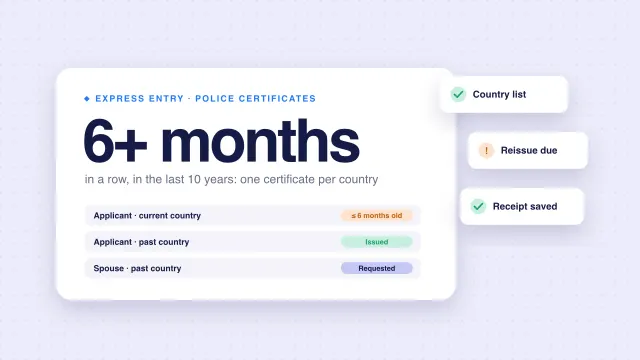
Certificates are needed for the client and family members 18 or older. One for each country where they stayed 6 months in a row or longer in the last 10 years. For the current country, the certificate must be issued no more than 6 months before the application is submitted. For other countries, it must be issued after the last 6-month stay there.
If one will not arrive within the 60 days, IRCC accepts a letter of explanation plus proof of the attempt, such as a receipt or tracking number.
If the officer is not satisfied the client made their best effort, IRCC says "your application may be rejected for being incomplete."
Check: list every country and stay from the address and travel history. Date-check each certificate against the submission date, not the invitation date. See the police certificate Express Entry checklist.
5. The score dropped after the invitation
IRCC tells candidates to recalculate their score before applying if their situation changed. Two examples it names: a work permit that expires before they apply, and language test results that have expired or came back lower on a retest. If the score drops below the round's minimum, IRCC says the candidate should decline. "If you submit your application anyway, we'll refuse it."
Check: re-run the CRS calculation on the day you finalize the file. Compare test expiry dates and work permit dates against your planned submission date.
6. Proof of funds that does not show what IRCC asks for
Federal Skilled Worker and Federal Skilled Trades candidates need proof of funds. Canadian Experience Class candidates do not. Neither do candidates authorized to work in Canada with a valid job offer. Bank letters must be on letterhead and show:
- Bank contact details and the client's name.
- Outstanding debts.
- For each account: the number, opening date, current balance and 6-month average.
IRCC says the money cannot be borrowed and real estate equity does not count.
Check: match each letter line by line against IRCC's list. More in the proof of funds Express Entry checklist.
7. Reference letters that leave out the basics
IRCC's supporting-documents guidance describes reference letters "with your job duties, dates you worked there, and salary." A letter that only confirms a job title leaves the work experience claim unsupported.
Check: for each job claimed, confirm duties, dates and salary appear in writing. See the Express Entry reference letter checklist.
8. Information that is not true, or not current
IRCC warns that if a candidate is not truthful in the profile or application, it may refuse the application, find them inadmissible, or bar them from applying for 5 years. If a concern like this arrives in writing, our procedural fairness letter response workflow covers the reply. Separately, IRCC asks candidates to report changes such as family composition, a new job or job offer, new language results or a new credential.
Check: compare the application against the profile that got the invitation. Any difference needs an answer: an update, an explanation or a correction.
One more deadline
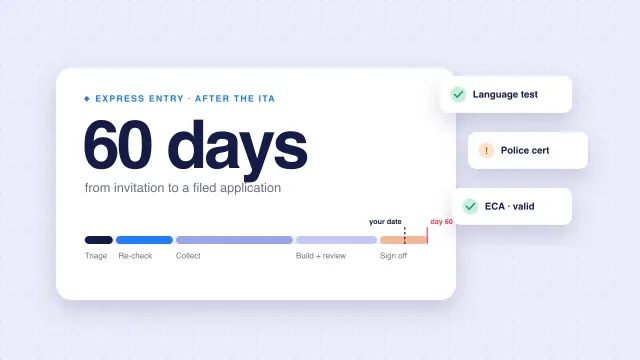
An invitation to apply is valid for 60 days. If the client does not apply or decline in that window, the invitation expires and the profile leaves the pool.
Put the expiry date in your calendar the day the invitation lands, and work back from it. Our Express Entry ITA checklist lays out that timeline.
How rcicaxis handles this
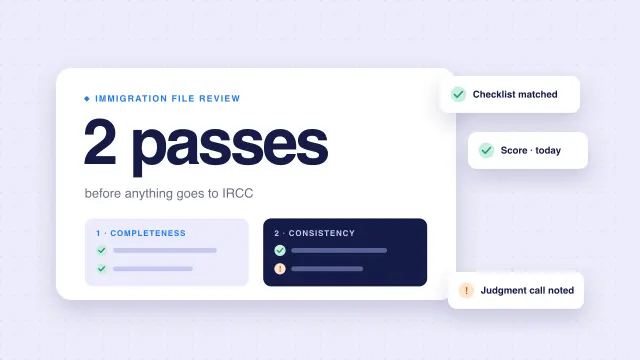
Argus runs 100+ checks on every file in an Express Entry case. It flags blockers, such as a missing or expired document, and judgment calls it leaves to you. It never advises or decides; you review the flags and sign. Deadline tracking for the 60-day window comes with reminders. For the step-by-step review itself, see our immigration file review checklist.
Questions
What happens if an Express Entry application is incomplete?
IRCC's after-you-apply page says: "If your application is not complete, we'll reject it and refund your processing fees." The candidate then needs a new profile and a new invitation.
Can a client still apply if their CRS score dropped after the invitation?
IRCC says that if the recalculated score drops below the minimum cut-off, the candidate should decline the invitation. If they submit anyway, IRCC says it will refuse the application.
What if a police certificate does not arrive within the 60 days?
IRCC allows a letter of explanation plus proof of the attempt, such as a receipt or tracking number. If the officer is not satisfied the client made their best effort, the application may be rejected as incomplete.
Who can translate documents for an Express Entry application?
A certified translator, or, only if a certified translator cannot do it, a translator who signs an affidavit. IRCC's page says family members and representatives cannot translate the documents.
Sources
- IRCC: Express Entry, after you apply
- IRCC: Apply for permanent residence through Express Entry
- IRCC: Express Entry, police certificates
- IRCC: Express Entry, proof of funds
- IRCC: Your IRCC application, supporting documents
IRCC facts checked against the sources above on November 10, 2026. This is practice guidance, not legal advice.