Procedural fairness letter response: an RCIC workflow
What your practice does from the day a procedural fairness letter arrives to the day the response is sent: log the deadline, tell the client, map every concern to evidence, review, send and record it all on the file.
A procedural fairness letter means an officer has a concern serious enough to refuse on. It is also the client's chance to answer it. Your procedural fairness letter response has to be complete, on time and backed by evidence. And your file has to show how you got there.
This is a workflow for the practice side of that response. IRCC and legal facts were checked on 14 November 2026 against the sources listed at the end. The steps are practice suggestions, not IRCC rules. This is practice-operations guidance, not legal advice. Federal Court decisions shape how these letters are read; check current case law for the client's facts.
What the letter is
IRCC's procedural fairness instructions say applicants must get a fair, unbiased assessment. They must be told the decision-maker's concerns and get a meaningful chance to respond. The instructions call this the right to know "the case to be met".
Per those instructions, the decision-maker should:
- Tell the applicant if they rely on evidence from another source, including third parties and IRCC partners.
- Give the essence of the concern and the specific provisions of the Act at issue.
- Tell the applicant which documents may be needed to address it.
New concerns from an interview can be put at the interview or in a procedural fairness letter afterwards. The instructions do not require IRCC to send the documents it relied on. So your response works from the letter's wording.
The deadline
The letter states how long the client has. IRCC's procedural fairness instructions do not set one number of days for every case. They do give one rule: if an applicant was given a period, such as 30 days, a negative decision should not be made before it ends.
Read the letter for two dates: the date it was sent and the date the response is due. Write both on the file, then add your own send date a few days earlier.
Day 1: Log and tell
- Save the letter to the file exactly as received, with the date it arrived.
- Record the deadline and how the response must be sent, as the letter states it.
- Set your internal send date and a reviewer.
- Assign one staff owner. Confirm which licensee will sign off.
- Send the client a copy and a plain summary: what IRCC is concerned about, what you need and by when.
- Book a call with the client within days, not weeks. Some answers only come out in conversation.
The College Code requires timely written information to the client on the status of their case, including when a document is received on their behalf (section 22(3)). A same-day notice covers that. See our client status update routine for the wider habit.
Map each concern to evidence
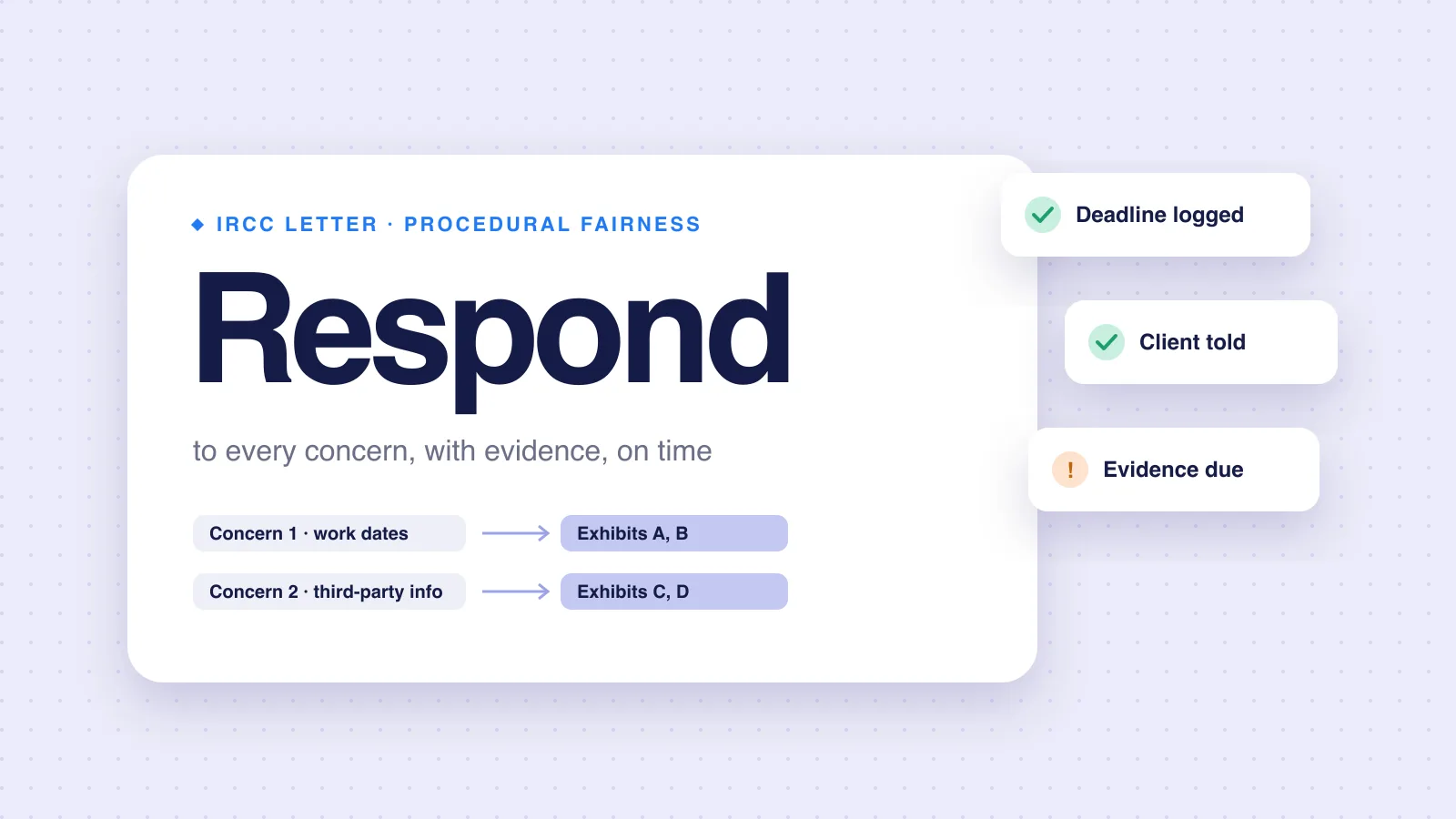
Letters often hold more than one concern. Split them out, number them in the letter's order, and give each its own row. A response that answers concern one in depth and skips concern three still leaves concern three open.
| Column | What goes in it |
|---|---|
| Concern | The officer's words, quoted from the letter |
| Provision cited | The section of the Act or Regulations the letter names |
| Source of the concern | The client's own documents, an interview, or another source the letter names |
| What is true | The client's account, confirmed on your call |
| Evidence | Each document that supports it, with an exhibit letter |
| Owner and due date | Who gets each document, and by your internal date |
Then check the concern against the file as filed. Many concerns trace back to a gap between the forms and the documents: work dates, job duties, family members, travel history. Our guide to Express Entry application mistakes lists the common ones. If the original file has the gap, the response has to explain it, not repeat it.
IRPA section 16(1) requires an applicant to answer truthfully and produce what an officer reasonably requires. The response is part of the application. Everything in it must be accurate, including what you add to fix an earlier error.
When misrepresentation is raised
If the letter cites section 40 of the Immigration and Refugee Protection Act, the stakes change. The section covers directly or indirectly misrepresenting or withholding material facts that induce, or could induce, an error in administering the Act.
5 yrs
A person found inadmissible for misrepresentation stays inadmissible for five years (IRPA s.40(2)(a)).
No PR
They may not apply for permanent resident status during that period (IRPA s.40(3)).
IRCC's instructions on representatives add two points every licensee should know. Misrepresentation can include misrepresentations made by authorized representatives. And representatives who take part in it are subject to discipline by their governing body. The same page says a person should always get a chance to respond to concerns about a potential misrepresentation.
- Move the file to the top of the queue. Shorten every internal date.
- Find where the fact came from: the client's answer, a document, or your practice's own preparation.
- If your practice's work is part of the concern, involve the licensee who owns the practice at once.
- Consider whether the client needs independent legal advice, and tell them in writing.
Write, review and send
-
Draft
A cover submission, point by point
Open with the file number and the letter's date. Answer each concern under its own heading, in the letter's order. Concede what is true, explain it, and point to the exhibit for every claim.
-
Draft
An exhibit index
List each exhibit with its letter, a short description and the concern it supports. Name files the same way. Our naming conventions work here too.
-
Draft
The client's own statement, where it helps
Some concerns turn on facts only the client knows. Their statement should be in their words, reviewed by them, and true.
-
Review
A second reader
Someone who did not draft it checks every concern has an answer and every claim has an exhibit. Use the same discipline as your pre-submission review.
-
Send
Through the channel the letter names
Send it the way the letter says. IRCC's web form has an option to update an application, for example to submit documents, but the letter's instructions come first. Save the confirmation and the exact files sent.
File notes
If the decision is ever reviewed, your file is the record of what the client knew and when. Keep notes as you go, not after.
- Date the letter arrived, and the deadline it stated.
- Date and method you told the client, and what you said.
- Each call with the client: date, who was on it, what was confirmed.
- Each request for evidence, and when it arrived.
- Any extension request: when, how, and the reply.
- Who reviewed the response and who signed off.
- The date sent, the confirmation, and a copy of every file sent.
- The date you sent the client a copy of the response.
The College Code also requires licensees to keep and preserve records under the College by-laws (section 37). Keep staff notes separate from what the client sees.
After you respond
None of the IRCC sources we checked give a timeline for a decision after a response. The instructions do say every document the applicant provides goes on the record. The record must show the decision-maker weighed all of the applicant's submissions. Tell the client that, and set a date to check the file status.
Then look back at the file. If the concern came from a gap you could have caught before submission, add that check to your review. Our Express Entry case management page shows how a practice runs files from invitation to submission.
How rcicaxis handles this
Clients upload evidence through the client portal, and case chat keeps the client conversation on the file. Staff-only notes keep your file notes beside the case, out of the client's view. Deadline rules with reminders keep each open file's dates in front of your team. Compose gives you documents as one PDF per section, with a cover page, contents and dividers. Argus runs 100+ checks on every file before sign-off, so fewer gaps reach an officer. You write the response and send it to IRCC yourself.
Questions
How long do you have to respond to a procedural fairness letter?
The letter states the deadline. IRCC's procedural fairness instructions do not set one number of days for every case. They do say that when an applicant is given a period, such as 30 days, a negative decision should not be made before it ends.
What triggers a procedural fairness letter?
A concern the officer must put to the applicant before deciding. IRCC's instructions say that if a decision-maker relies on evidence from a source other than the applicant, including third parties, they must tell the applicant and give them a chance to respond. New concerns from an interview can also be raised this way.
Can you ask IRCC for more time?
The IRCC instructions we checked do not cover extensions. As a practice rule, ask in writing before the deadline, through the channel the letter names, give a reason and a date, and keep proof you asked. Do not assume it is granted.
What is the penalty for misrepresentation?
Under IRPA section 40, a person found inadmissible for misrepresentation stays inadmissible for five years and cannot apply for permanent residence during that period.
How long does IRCC take to decide after a response?
None of the IRCC sources we checked give a timeline. The instructions do say every document the applicant provides must be placed on the record, and the record must show the decision-maker weighed all of the applicant's submissions.
Sources
- IRCC: Procedural fairness (program delivery instructions)
- Immigration and Refugee Protection Act, section 40 (misrepresentation)
- Immigration and Refugee Protection Act, section 16 (obligation to answer truthfully)
- IRCC: Use of representatives, misrepresentation
- IRCC: Contact IRCC using the web form
- College of Immigration and Citizenship Consultants: Code of Professional Conduct (SOR/2022-128)
IRCC and legal facts checked against the sources above on November 14, 2026. This is practice guidance, not legal advice.