Letter of explanation for Express Entry: an RCIC guide
When your practice should draft a letter of explanation on an Express Entry file, what goes in it, which field it goes in, and the proof that has to travel with it.
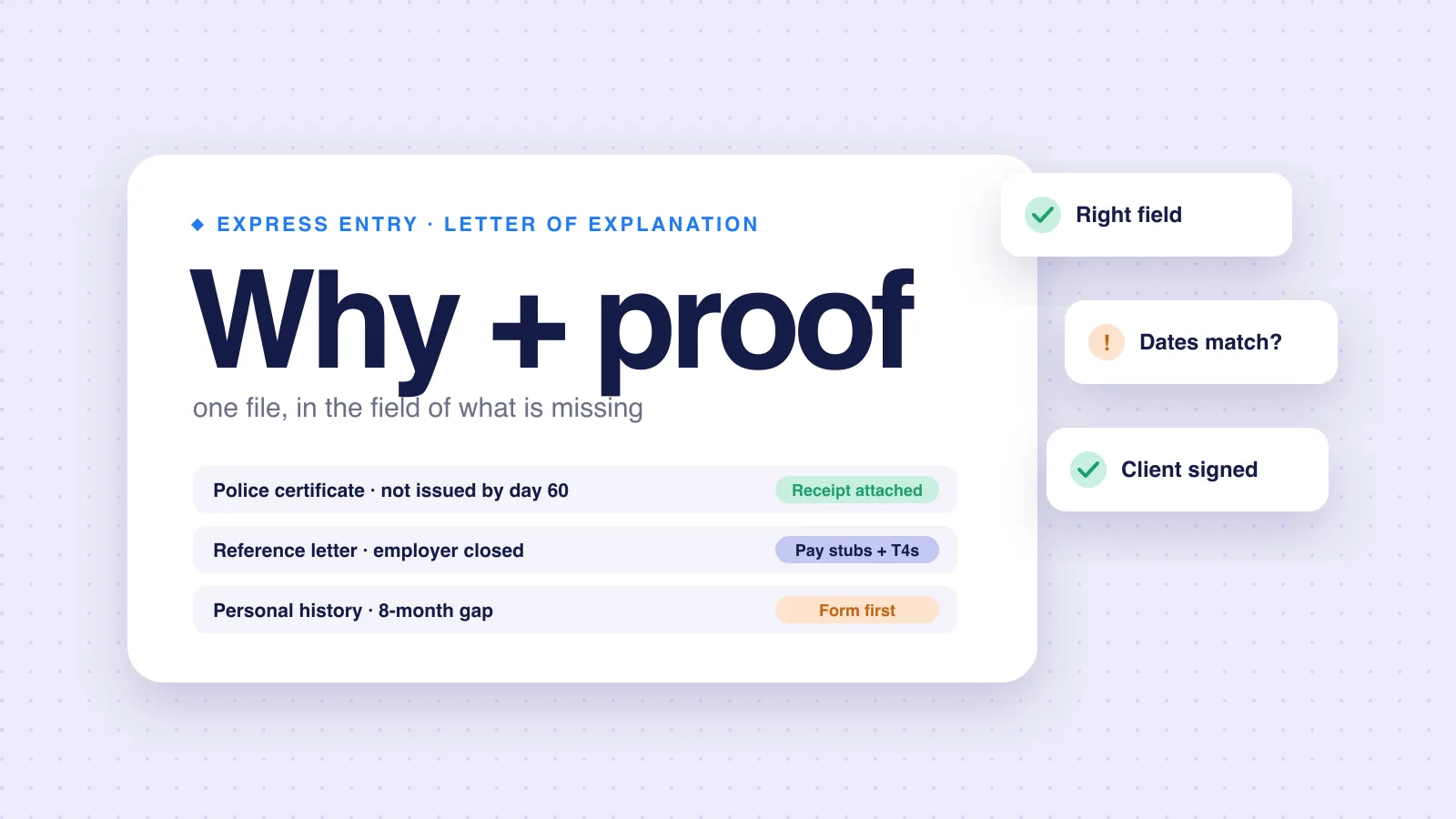
Most Express Entry files have one thing that does not fit. A police certificate that will not arrive in 60 days. An employer that closed and cannot write a reference letter. Eight months between jobs that the client forgot to mention. A letter of explanation is how your practice tells the officer what happened, before the officer has to ask.
This guide is for the RCIC drafting that letter, not the applicant. IRCC facts were checked on 14 November 2026 against the pages in the sources. Where we say "practice advice", that is our suggestion, not an IRCC rule.
What IRCC says about letters of explanation
IRCC's general rule is short. If a required document is missing, the application could be delayed, returned or refused. When the client cannot get a document, IRCC says to write a letter explaining why, or why it is taking longer. Add supporting proof, such as receipts. For an online application, combine the letter and proof into one file and upload it in place of the missing document.
Then the officer decides. IRCC lists four outcomes: contact the client for more information, grant more time, treat the application as complete without the document, or make a final decision on what was sent.
1 file
Letter plus proof, combined, uploaded where the missing document would go.
60 days
The window after an invitation. A late police certificate still needs something in its field by then.
10 years
Personal history goes back 10 years or to age 18, whichever is more recent. No gaps.
When to draft a letter of explanation for Express Entry
Not every oddity needs a letter. Too many letters bury the one that matters. Use this table at file review.
| Situation | Letter? | What travels with it |
|---|---|---|
| Police certificate requested, not issued by day 60 | Yes, IRCC asks for one | Proof of effort: receipt, tracking number, authority's reply |
| Police certificate cannot be issued at all | Yes | Proof of the request and of why it cannot be issued |
| Employer closed or refuses a reference letter | Yes (practice advice) | Contracts, pay stubs, tax documents |
| Gap between jobs or studies | Form first | Personal history entry: unemployed, studying, travelling |
| Name spelled differently across documents | Often (practice advice) | The documents that link the names |
| Extended passport (IRCC's Venezuela example) | Yes, IRCC gives the wording | The passport itself |
Late police certificate
This is the case IRCC spells out best. IRCC says that if the client does not have every police certificate by the 60-day deadline, you can provide a letter of explanation and proof of best effort. Both go in the country-specific police certificate field.
IRCC's supporting documents page says the letter must explain all the efforts taken. It must also show the request went to the correct authority. IRCC's examples of proof:
- A confirmation or payment receipt for the request.
- A delivery notice or tracking number.
- An explanation from the authority about the delay, or why it cannot issue one.
- A screenshot of the authority's website, or similar.
- A description, written into the letter, of the situation in that country that prevents getting one.
IRCC says that if the officer is not satisfied the client made a real effort, the application may be rejected as incomplete. A letter with no proof is the weakest version.
Start the request early, so the paper trail exists. Our police certificate checklist covers which countries need one and when.
Missing reference letter
IRCC's Express Entry documents page lists proof of work experience "such as a reference or experience letter from an employer". IRCC's general supporting documents guidance also lists contracts, pay stubs and tax documents as proof of employment.
When the employer closed, the manager left or the company refuses, the practice move is the same:
-
Collect what exists
Contracts, pay stubs, tax slips, bank deposits of salary. Match each to the dates and duties in the profile.
-
Record the attempt
Emails to the employer or HR, a registry record showing the company closed, a reply that refuses. These are the receipts.
-
Write the letter
Why the reference letter cannot be provided, what was tried, and what each attached document proves.
-
Decide if it is enough
Your judgment decides whether the evidence supports claiming that experience. If it does not, say so to the client before filing.
For what a full reference letter needs, see our Express Entry reference letter checklist.
Employment gaps
Gaps are answered on the form before any letter. IRCC's Schedule A instructions ask for personal history for the past 10 years, or since age 18 if that is more recent. They say not to leave gaps. When the person was not working, IRCC says to explain what they were doing: unemployed, studying, travelling, and so on. IRCC says processing may be delayed if time is not accounted for.
So the first fix is a complete form. Practice advice: write a letter only when the form entry would leave an officer with a question. Examples:
- A gap that overlaps a claimed work period in another country.
- Two jobs at once, where hours matter for the points claimed.
- A long stay in a country that triggers a police certificate.
- History that differs from an earlier IRCC application.
Practice advice: treat the last one as the most important. Assume an officer may compare this file with earlier ones. If it says something different, explain it.
How to write a letter of explanation
IRCC does not publish a template for Express Entry. This structure is practice advice. It keeps letters short and easy to check.
-
Header
Client's full name as on the passport, date of birth, application number if known, and the checklist item the letter is about.
-
The issue, in one sentence
"The police certificate from Country X has been requested but not yet issued."
-
What happened, with dates
Each step in order: when requested, from which authority, what came back. Dates must match the attachments.
-
What is attached
A numbered list. Each item names the document and what it proves.
-
What happens next
For a late document, when you expect it and that the client will send it once issued.
-
Signature
IRCC's pages do not set a signer. The facts are the client's, so many practices have the client confirm and sign.
Keep it to facts. The Immigration and Refugee Protection Act says applicants must answer truthfully. Do not argue, plead or guess. Every sentence should be one the client can stand behind and a document can back up.
If any attachment is not in English or French, it needs a translation. See our IRCC translation guide.
Where it goes in the portal
- Replacing a missing document: letter and proof combined into one file, uploaded in that document's field.
- Late police certificate: the country-specific police certificate field, as IRCC says.
- Extra context: IRCC's help centre says to choose "add letter of explanation" in the Optional documents section of the checklist.
Practice advice: one letter per issue. A single letter covering five topics is hard to find and easy to miss. Name each file so a reviewer knows what it explains. Our Express Entry document checklist maps every field.
Review before filing
- Every date in the letter matches the form, the profile and the attachments.
- Every attachment listed is actually in the combined file.
- The letter sits in the field it explains.
- The client has read it and confirms it is true.
- A copy is saved on the file with what was uploaded.
Our pre-submission review checklist covers the rest of the package. A letter from IRCC raising a concern is a different job: see our procedural fairness letter response workflow.
How rcicaxis handles this
Clients upload the receipts, emails and records behind each letter through the client portal. Staff-only notes keep the internal story of each issue next to the case, away from the client. Compose builds one PDF per section with a cover page, contents and dividers. Argus runs 100+ checks on every file and flags blockers and warnings before your sign-off. You file with IRCC yourself.
Questions
Where does a letter of explanation go in an Express Entry application?
If it replaces a missing document, IRCC says to combine the letter and its proof into one file and upload it in place of that document. For a late police certificate, that is the country-specific police certificate field. For extra context that replaces nothing, IRCC's help centre points to "add letter of explanation" in the Optional documents section of the checklist.
Does a letter of explanation guarantee IRCC accepts a missing document?
No. IRCC says each case is different. The officer may ask for more information, give more time, treat the application as complete, or decide on what was submitted. For police certificates, IRCC says a letter and proof of effort do not guarantee acceptance.
Do employment gaps need a letter of explanation?
The first step is the form. IRCC's personal history instructions say not to leave gaps and to explain what the person was doing when not working, such as unemployed, studying or travelling. A separate letter is a practice choice when the form entry alone would leave an officer with questions.
Who should sign the letter of explanation?
IRCC's pages do not set a signer. In practice the facts are the client's, so many RCICs draft the letter and have the client confirm and sign it. The law requires applicants to answer truthfully, so every statement must be one the client can stand behind.
Sources
- IRCC: Your IRCC application, supporting documents
- IRCC: Express Entry, police certificates
- IRCC: Immigrate through Express Entry, documents
- IRCC: Schedule A, Background / Declaration (IMM 5669)
- IRCC Help Centre: I don't have a document I need to submit
- IRCC Help Centre: How do I fill out an IRCC application?
- Immigration and Refugee Protection Act, section 16
IRCC facts checked against the sources above on November 14, 2026. This is practice guidance, not legal advice.