IMM 5409 and common-law proof for Express Entry
What IRCC asks for when an Express Entry client declares a common-law partner: the IMM 5409 declaration, who signs it, and how your practice checks 12 months of cohabitation proof.
A client says "we live together". That one sentence changes the file. The status on the profile becomes common-law. A partner joins the application. And IRCC wants IMM 5409, the Statutory Declaration of Common-Law Union, with proof behind it.
This guide is for the RCIC running that file, not the applicant. IRCC facts were checked on 17 November 2026 against the pages in the sources. Where we say "practice advice", that is our suggestion, not an IRCC rule.
What IRCC asks for on an Express Entry file
IRCC's Express Entry application page lists the common-law union form, IMM 5409, among the documents most applicants upload, "if you've declared your marital status as common-law".
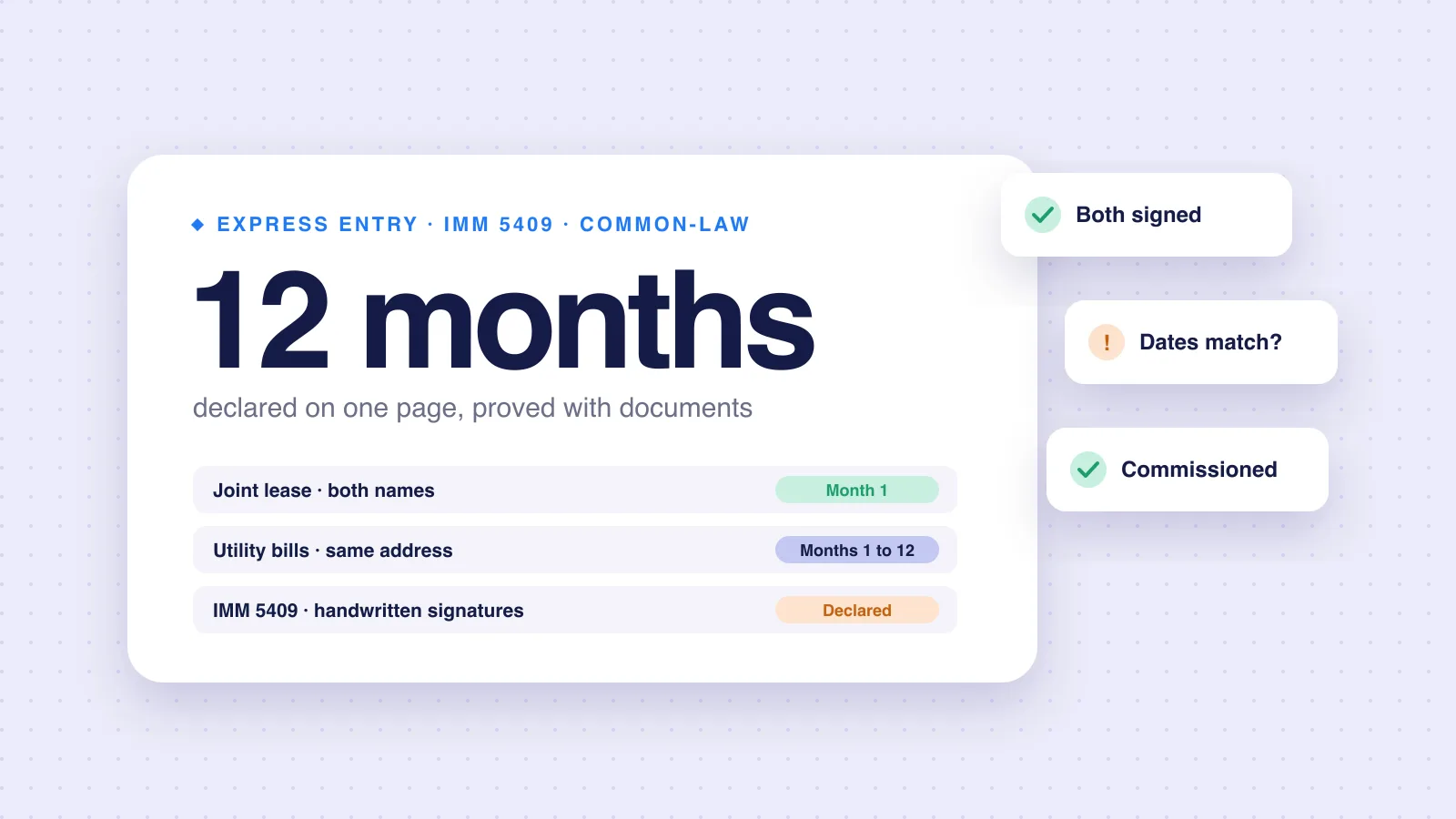
IRCC's completeness check instructions go further. They say this evidence is requested only when marital status is listed as common-law. The applicant must then submit IMM 5409 and evidence of cohabitation for at least 12 continuous months. The instructions give three examples of evidence and say the list is not limited to them: joint bank account statements, leases and utility bills.
12 months
Continuous cohabitation that the evidence has to show.
2 partners
Both sign IMM 5409 by hand, before the person who administers the declaration.
1 page
The current form is IMM 5409 (01-2023). It makes no barcode when validated.
The instructions list this under mandatory documents "if applicable". When they apply and are missing, IRCC says the application is rejected as incomplete and fees are refunded. The client then needs a new profile to be considered again.
Our IRCC incomplete application guide covers the full completeness check. The Express Entry document checklist for consultants lists every other document on the file.
Who counts as a common-law partner
The Immigration and Refugee Protection Regulations define it in section 1. A common-law partner is a person who is cohabiting with another in a conjugal relationship, and has done so for at least one year.
IRCC's guidance to officers explains "cohabiting". It was written for family class files, but it reads the same definition. Its main points:
- The year is continuous. Short stays that add up to a year do not count.
- Time apart for work, business travel or family obligations is fine if it is temporary and short.
- The relationship exists from the day the couple can show evidence of cohabiting.
- The onus is on the applicant to prove it.
- Both partners must be 18. The year is counted from when both were at least 18.
The regulations add one exception. A person in a conjugal relationship for at least a year who cannot cohabit because of persecution or penal control is still treated as a common-law partner.
IMM 5409, section by section
The form is one page. IRCC's form page was last updated in January 2023 and the PDF is marked IMM 5409 (01-2023) E. Get it from IRCC's IMM 5409 page each time, not from a saved copy.
One thing to know first. The "who must complete this form" note on that page speaks only about sponsorship. The Express Entry requirement comes from the two Express Entry pages above.
-
Top block
Names, place and dates
Country and province of residence. Both full names, as shown on the passport or travel document. The city and country. The number of continuous years in a conjugal relationship, and the from and to dates.
-
Question 1
Four yes or no boxes
A joint lease, mortgage or purchase agreement for the home. Jointly owned property other than the home. Joint bank, trust, credit union or charge card accounts. A common-law union declared on a Canadian T1 tax return.
-
Questions 2 and 3
Life insurance
Whether each partner has life insurance that names the other as beneficiary.
-
Question 4
Other evidence
IRCC says to fill this in if the answers to questions 1 to 3 were "no". List the other documents that show the relationship.
-
Question 5
Solemn declaration
Both names, both signatures, the place and date, and the name, title and signature of the person who administered it.
Practice advice: every "yes" in questions 1 to 3 is a promise of a document. If the box says there is a joint lease, the joint lease should be in the file.
IRCC says to press the Validate button before printing. It flags missing fields. IRCC notes that this form does not produce a barcode.
Who signs IMM 5409, and where
IRCC's form page says the form must be completed and signed with handwritten signatures.
| Person | What they write | Where |
|---|---|---|
| Declarant | Name as on the passport, handwritten signature | Question 5, first line |
| Declarant's partner | Name as on the passport, handwritten signature | Question 5, second line |
| Person who administers the declaration | Name, title, signature, place and date | Question 5, "Declared before me" |
The form offers three titles for that person: Notary Public, Commissioner of Oaths, or Commissioner of Taking Affidavits.
The declaration says it has the same force as if made under oath. Tell both partners that before they sign. The partner usually signs the representative form too. See our IMM 5476 guide for who signs that one.
Common-law proof for Express Entry: the 12 months
The declaration alone is not enough. IRCC asks for it "and" evidence of cohabitation. This table puts IRCC's own lists side by side.
| Evidence | Where IRCC names it | What to check (practice advice) |
|---|---|---|
| Joint lease, mortgage or purchase agreement | Form question 1a, Express Entry instructions, Help Centre | Both names, the address, the start date |
| Joint bank or card account statements | Form question 1c, Express Entry instructions | Both names, statements spread across the year |
| Utility bills: gas, electricity, telephone | Express Entry instructions, Help Centre | Same address, early and late in the year |
| Common-law status on a T1 tax return | Form question 1d | The tax year falls inside the declared dates |
| Life insurance naming the partner | Form questions 2 and 3 | The page that names the beneficiary |
| Driver's licences, insurance policies or ID at the same address | Help Centre | Issue dates, and that the address matches |
| Jointly owned property other than the home | Form question 1b | Both names on the ownership record |
IRCC's Help Centre answer, written for sponsorship, says a couple does not need every item and that IRCC may consider other proof. No IRCC page we checked gives a number of documents that is enough.
Practice advice: think in coverage, not count. One document from month 1 and one from month 12 leaves ten months open. Aim for something dated in each quarter, from at least two kinds of evidence.
Any document not in English or French needs a translation. See our IRCC translation guide.
Hard cases
These come from IRCC's guidance to officers on assessing a common-law relationship. It was written for family class files and last modified in 2019. Treat it as how IRCC reads the definition, not as an Express Entry checklist.
| Situation | What the guidance says |
|---|---|
| The couple lived together on and off | Intermittent cohabitation that adds up to a year does not meet the definition. |
| Living apart now, after a full year together | The relationship can continue if they intend to live together again as soon as possible. The longer apart, the harder to show. |
| One partner is still legally married to someone else | Possible if that marriage has broken down and they have lived apart from the spouse for at least a year while cohabiting with the partner. |
| They moved in together before age 18 | The year counts only from when both were 18. |
| An earlier common-law relationship | It ends when at least one partner does not intend to continue it. An officer may look for evidence of that. |
One more case is about timing. A couple can reach 12 months after the profile was created. IRCC's application page says that if the client's situation changes, they should re-calculate the score before applying. Practice advice: ask about living arrangements at intake and again at the invitation. Our Express Entry ITA checklist has the full list of what to re-check.
When the evidence is thin for a good reason, such as a lease in one name only, explain it. Our guide to the letter of explanation for Express Entry shows how.
Checks before it goes in the file
All of this is practice advice. It is the review we would run on IMM 5409 and its evidence.
- The form is the current edition from IRCC's page, validated, then printed.
- Both names match the passports, letter for letter.
- The "from" date is at least 12 months before the declaration date.
- The from date and address agree with the address history on Schedule A (IMM 5669).
- The partner's details agree with IMM 5406 and the profile.
- Every "yes" box has its document in the file.
- Both signatures are handwritten. The administrator's name, title, signature, place and date are all filled in.
- Evidence covers the full 12 months, with no quarter empty.
- The scan is complete and legible, and a copy is saved on the case.
Our pre-submission review checklist covers the rest of the package.
How rcicaxis handles this
Clients upload the lease, bills, statements and the signed declaration through the client portal. Staff-only notes keep your read of the evidence next to the case, away from the client. Compose builds one PDF per section with a cover page, contents and dividers. Argus runs 100+ checks on every file and flags blockers and warnings before your sign-off. You file with IRCC yourself.
Questions
Is IMM 5409 required for Express Entry?
Only when the marital status is listed as common-law. IRCC's completeness check instructions say the applicant must then submit the Statutory Declaration of Common-Law Union (IMM 5409) and evidence of cohabitation for at least 12 continuous months. IRCC lists it with the documents that, when they apply, lead to rejection as incomplete if missing.
Who can administer the IMM 5409 declaration?
The form gives three titles to choose from: Notary Public, Commissioner of Oaths, or Commissioner of Taking Affidavits. That person writes their name, picks their title and signs the form, along with the place and date of the declaration.
Can IMM 5409 be signed electronically?
IRCC's form page says the form must be completed and signed with handwritten signatures. The page does not say whether the declaration can be administered by video. That is a question for the notary or commissioner. Practice advice: ink signatures from both partners and the administrator, then scan.
What counts as proof of 12 months of cohabitation?
IRCC's Express Entry instructions name joint bank account statements, leases and utility bills, and say the list is not limited to those. The form itself asks about a joint lease or mortgage, jointly owned property, joint accounts, a common-law status declared on a tax return and life insurance naming the partner. IRCC does not publish a number of documents that is enough.
Sources
- IRCC: Statutory Declaration of Common-Law Union (IMM 5409), form page
- IRCC: IMM 5409 (01-2023) E, the form (PDF)
- IRCC: Express Entry, apply for permanent residence
- IRCC: Express Entry completeness check instructions
- IRCC: Assessing a common-law relationship
- IRCC Help Centre: proving 12 months together
- IRCC Help Centre: what is a common-law partner
- Immigration and Refugee Protection Regulations, section 1
IRCC facts checked against the sources above on November 17, 2026. This is practice guidance, not legal advice.